
F&M Stories
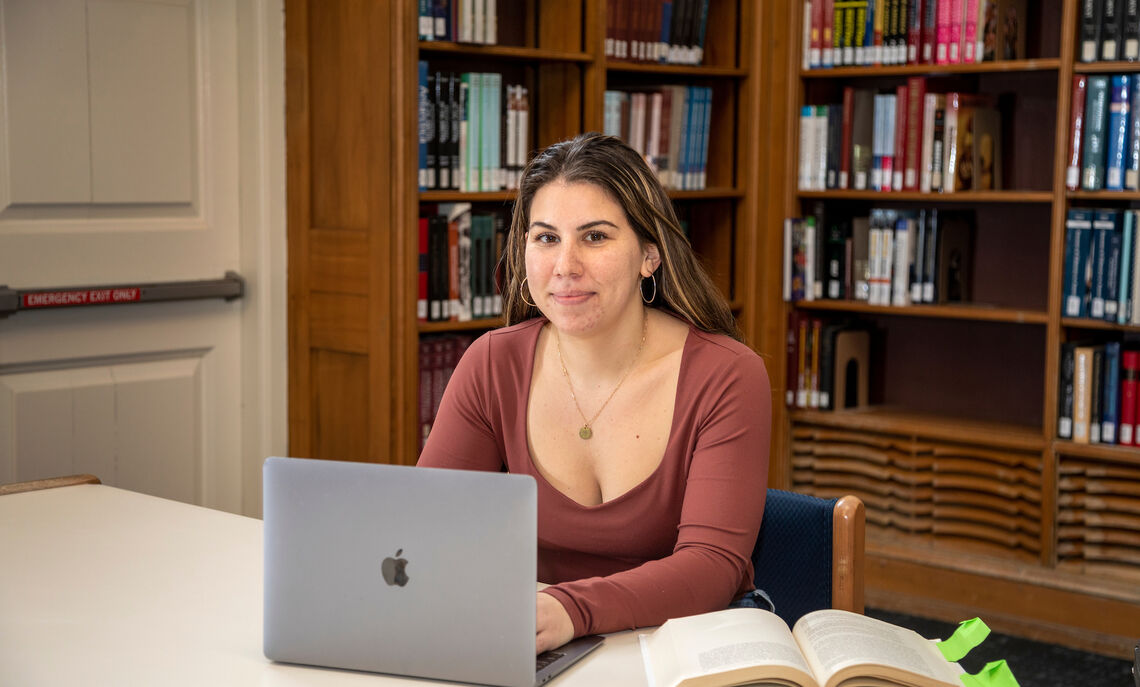
Senior Studies Russian Politics in Real Time
As Franklin & Marshall College senior Anna Synakh began researching Russian soft-power politics, her studies took a startling turn.
The Kremlin's invasion of Ukraine in February added a new dimension to her work — one that felt particularly close to home.
"I am a Ukrainian immigrant who moved here with my parents back in 2012. Only two years later, Russia invaded Crimea," Synakh said.
Now a joint international studies and government major, Synakh is analyzing Western country responses to Russian propaganda, disinformation and hybrid warfare from the early 2000s to present day.
As a staff writer for The College Reporter, Synakh is well on her way toward her goal to increase focus on Ukraine and other Eastern European countries through journalism and other media.
Below, Synakh discusses her research motives, methods and findings.


Please summarize your work.
The aim of my thesis is to highlight the less perceptible spheres within the soft-power influence emitted by Russia in foreign affairs, such as misinformation campaigns in Western countries with influence, propaganda campaigns within post-Soviet states that still carry geographic and economic value, and hybrid warfare strategies within adjoining nations which combine the intricacies of both hard (coercive) power and soft (persuasive) power forces.
Through analyzing both policymakers' and foreign policy experts' perspectives on Russian strategies, considering the historical outcomes of a lack of foreign countermeasures to a rising Russian force in Eastern Europe, and assessing the current state of Russian influence in countries such as Belarus and Ukraine, my research argues for rapid engagement from Western countries and a shift to long-term cost analysis of disregard for Russian power control over Eastern Europe.
What inspired you?
As we watched our home country get torn apart [in 2014], the West provided little to no response, despite the existing agreements to protect Ukraine's sovereignty.
Throughout my U.S. education, I saw similar patterns emerging in many conflicts: The U.S., Germany, and other major economic powers had a responsibility to act, but chose to focus on the short-term benefits of inaction. Over the past few years, my interest in Eastern Europe deepened, and by the end of my junior year, I knew I wanted to do a thesis highlighting the often hidden sides of Russian influence, and draw attention to potential long-term outcomes.
What surprised you?
I was going to argue that Russia's invasion of Ukraine in 2014 had major international consequences, and was one of many steps of a long-term plan. What was surprising is that before I could even start officially writing, the consequences I was going to predict were already happening.
Related Articles
September 30, 2026
Patricia E. Harris '77 to Receive Inaugural Benjamin Franklin Distinguished Innovator Award
This fall, Franklin & Marshall College will debut a new honor and celebrate the career and leadership of one of its most accomplished graduates: Patricia E. Harris '77, Bloomberg Philanthropies CEO, former first deputy mayor of New York City, and Trustee Emerita.
September 24, 2026
F&M Poll: Economic Concerns Shape Voter Attitudes in Pa. 7th and 10th Districts
The preferences of registered voters living in Pennsylvania’s 7th and 10th Congressional Districts show patterns that are similar to state and national data that favor Democratic candidates, according to the latest Franklin & Marshall College Poll.
September 18, 2026
Lessons in Leadership: Entrepreneur Lynn Greenberg ’14
Lynn Greenberg ’14, founder and CEO of Pivt Enterprise, recently returned to F&M to share wisdom and kick off a lecture series at F&M presented by The Mehlman Leadership & Performance Institute. “F&M is the perfect place to lead you into entrepreneurship,” she said.