
English
About English
Our Program and Courses
You can major or minor in English at F&M. A major in English follows one of two complementary tracks: creative writing or literature. No matter which track you select, you will gain some experience in both areas.
Creative Writing
Enter a gateway to a lifelong love and appreciation of reading and writing. F&M’s English creative writing track is built upon the premise that reading widely and deeply in literature — including contemporary literature — is essential to becoming a skilled creative writer. The best writers are also avid, engaged readers. Blending your passion for language and imaginative writing with the study of literature, you will explore poetry, fiction, and nonfiction and practice the craft yourself in workshop settings where writing is valued as a serious artform. The creative writing track culminates in an advanced workshop in which you will complete a creative thesis in the genre of your choice.Literature
The study of literature fosters an engagement with the big questions of living—questions about language, meaning, and value. It fosters self-reflection and greater awareness of the natural and social worlds in which we live. Moreover, studying literature gives us a purchase on how narratives and metaphors work so that we can interpret and deploy them wisely and even re-make them for our own time, with its enormous challenges and demands. You’ll study the traditional periods of British and American literature as well as Native American literature, Caribbean literature, African literature, science fiction, contemporary young adult literature, graphic novels, and more. You will also take at least one course in creative writing to appreciate the craft imaginative literature entails and perhaps to spark your own interest in creative writing.By the time you graduate with your F&M English degree, you will be able to demonstrate these skills:
- Reading actively and mindfully, including the ability to read figuratively, analytically, and interpretively.
- Writing, including the ability to write clearly, fluently, and persuasively; incorporate evidence gracefully; use discipline-specific language; use appropriate tone; and write with rhetorical deftness.
- Argumentation, including the ability to gather and deploy evidence, whether textual or contextual, in literary analysis and develop competencies and skills to structure and organize information from literary and secondary sources.
Learning Outside the Classroom
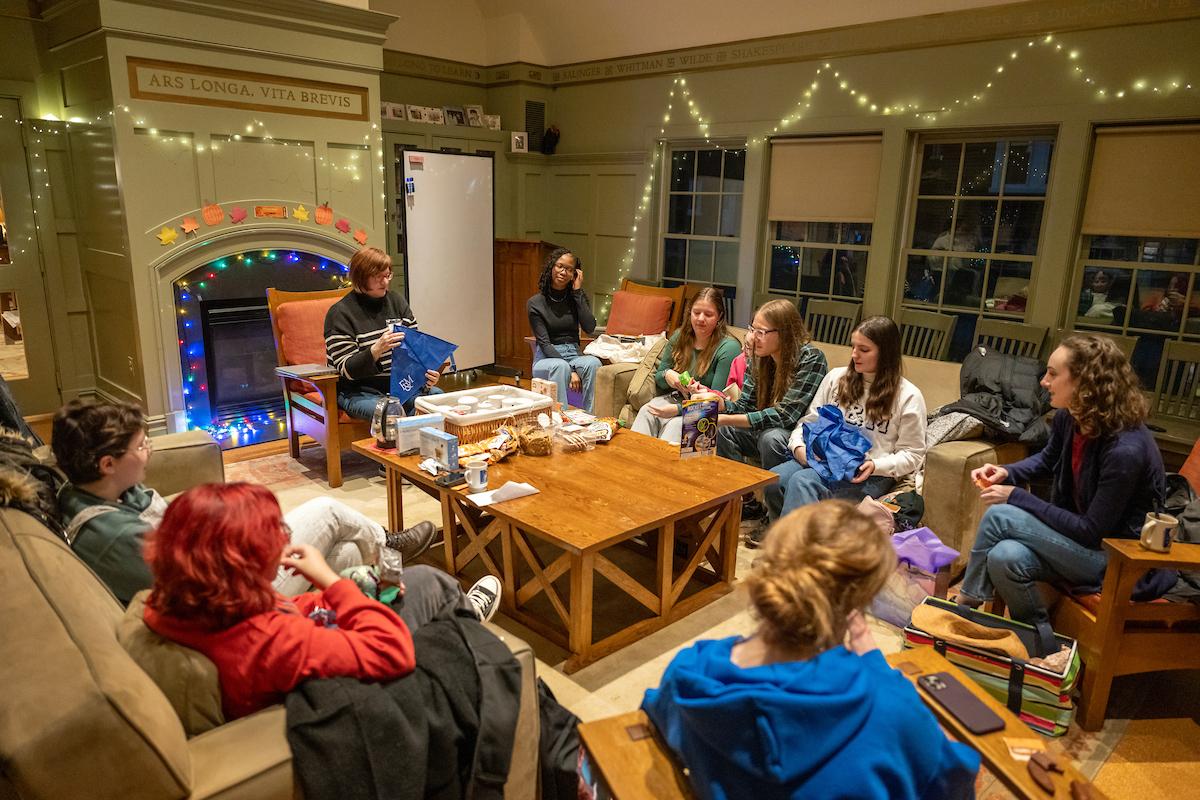
The Philadelphia Alumni Writers House
Unique among selective liberal arts colleges, F&M’s Writers House is an actual house — complete with comfy couches, a kitchen, and a picturesque fireplace — with a mission to give the writing and reading community exciting opportunities to fully immerse themselves in wordcraft and literature.Explore the Writers House at F&M
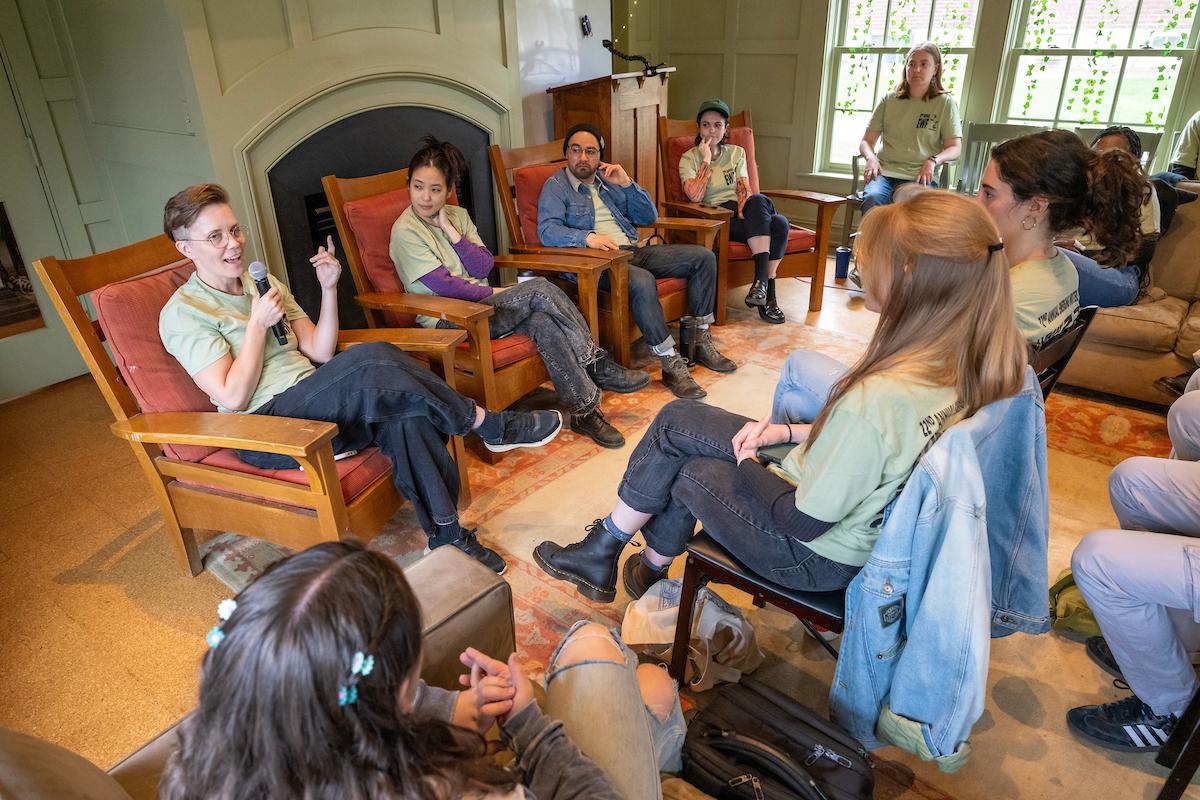
The Emerging Writers Festival
Every year, F&M’s English department partners with the Writers House to host the Emerging
Writers Festival. A hallmark literary tradition on campus, the Emerging Writers Festival
is a three-day event that invites the country’s most exciting emerging authors to
F&M to host readings, craft talks, and writing workshops. The festival is a collaborative
effort between students and faculty, offering students hands-on experience in bringing
a literary festival to life.Learn more about F&M’s Emerging Writers Festival
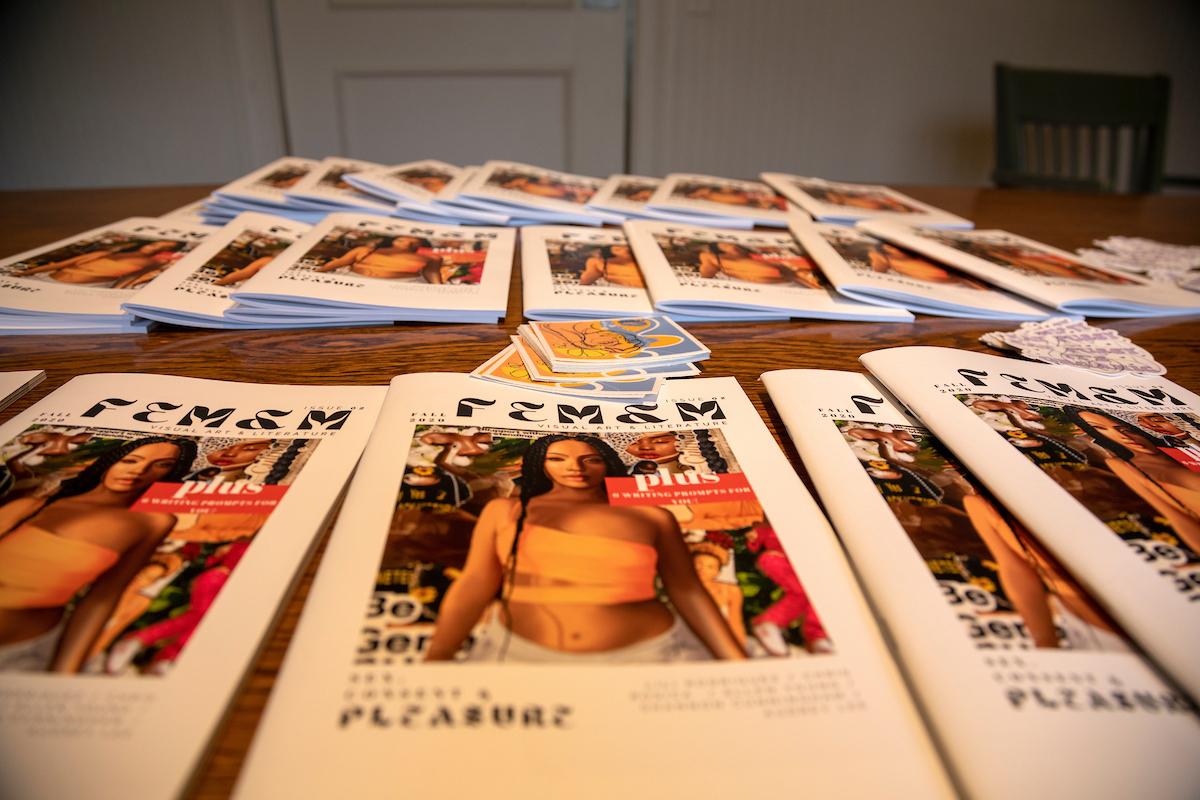
F&M Literary Publications
If you're eager to find an audience for your writing beyond the classroom or gain editing and production experience, you can write for or staff one of F&M's many literary publications:- The College Reporter, F&M’s student newspaper
- Epilogue, a literary magazine celebrating the creative works of F&M students, including fiction, nonfiction, poetry, and art.
- boy-band, a quarterly magazine with two sections: a lifestyle section focusing on conscious living, fashion, and entertainment, and a literary section featuring F&M authors and poets.
- FEM&M, a fresh, feminist-focused literary and visual arts magazine
Research and Independent Study
At F&M, we provide resources and opportunities to make hands-on learning the cornerstone of our educational experience. English majors have learned bookbinding techniques, created a graphic novel to explore art and writing in storytelling, examined Native American letters and articles, written and self-published a novel, and more.Explore research at F&M
Internships for Credit
Don't wait to fuel your dreams. Internships not only enrich your academic journey, but also allow you to immerse yourself in the day-to-day life of your field prior to entering the workforce. You can even submit an application to earn academic credit for your internship experience.Explore internships at F&M
Off-Campus Study
Analyze 19th-century horror fiction while you live in Bram Stoker’s birthplace. Retrace the imaginative journey of Hans Christian Andersen along Copenhagen’s Nyhavn Canal. Craft your budding fantasy novel on the banks of Loch Ness. Off-campus study at F&M offers immersive experiences that amplify your academic journey. You will work with your academic adviser and your off-campus study adviser for a full year to craft an experience that complements your F&M degree and goals. English majors also have the opportunity to apply for the Alice and Ray Drum British Isle Summer Travel Award, an award that supports summer research in the British Isles.Explore off-campus study at F&M
Creative Writing & Cultural Leadership Fellows
Grow as a writer — and effect cultural change.
Franklin & Marshall College has always been known for the excellence of our writing education. For us, the act of writing is inseparable from critical thinking, creative invention, and leadership. Students who come to F&M, regardless of their ultimate major, learn how to write so that they can have social and cultural impact. Writing is a gateway for finding and expanding audiences for their ideas and research, moving people with their words, and leading meaningful change.If you’re passionate about writing, reading, literary activism, and creative expression, you have the unique opportunity to participate in a vital writing community during your college years at the Philadelphia Alumni Writers House. This program space and community hub is an actual house that serves as an incubator for students in all academic disciplines to develop their writing and related creative projects. In just the past few years, students at Writers House have published their own work in journals, founded new writing groups and literary journals, brought well-known authors to campus for readings and workshops, taught creative writing in local public schools and community centers, hosted a campus-wide Banned Books Fair, and met with alumni in writing-related fields, among many other projects. Students here find their voices figuratively and literally while connecting with both faculty writers from across the College and a deep pool of successful alumni in writing and creative fields.
Our Creative Writing & Cultural Leadership Fellows program is designed for students like you with a keen interest in creative writing of all kinds and/or related creative fields including publishing, journalism, storytelling, cultural criticism, arts and museum administration, design thinking, and performance. As a Creative Writing & Cultural Leadership Fellow, you will:
- explore the craft of creative writing and grow as a writer
- gain knowledge of literary and cultural activism on both F&M’s campus and in Lancaster
- partner with one of several local cultural and educational institutions to develop a writing-related program, event, workshop, or other project for a new audience
- work within the Writers House community to help produce one new writing-related program or project on campus
- meet several times a semester with alumni who work in writing and related creative fields
- participate in leadership training through the Leadership & Performance Lab
- develop experience, expertise, and confidence as both a writer and cultural leader
- receive individual faculty mentorship and programmatic support throughout the program
Degree Partnerships
Through this shared initiative, up to 10 F&M graduates admitted to Heinz College’s master’s degree programs annually will receive scholarships that reduce tuition by at least 30% each semester. F&M graduates will also be eligible for consideration for additional merit-based scholarship support up to 100%.
The collaboration expands postgraduate pathways for F&M students seeking advanced degrees and will apply to all Heinz College master's degree programs, including:
The scholarship is effective for any F&M graduate seeking to apply to Heinz College in the Fall 2026 application cycle and beyond. The award will be made at the time of admission and no separate application is necessary.
Success Beyond F&M
The impact of an F&M education is reflected strongly in our graduates’ outcomes. Within six months after graduation, 92% of the Class of 2025 were either employed or furthering their education. This is higher than the national average, which is typically in the mid-80% range.
English majors who graduate from F&M are particularly adept at collaboration and self-reflection, reading and analysis, critical and creative thought, and a greater perspective and understanding of the world. These useful and productive skills make you an attractive candidate for any post-graduate pursuit.
Graduate School
With a breadth of study that is uncommon at other liberal arts colleges, our graduates are immediately prepared to pursue advanced degrees upon graduating from F&M. Past F&M English majors have entered graduate programs studying English, creative writing, publishing, children’s literature, advertising, marketing, law, and more.Fellowships
It’s not uncommon for English majors to pursue fellowships, which offer often-funded experiential learning opportunities such as advanced study, research, internships, service, travel, and more. Our graduates have pursued teaching and public service fellowships with organizations such as Teach for America and Americorps. They also go on to complete fellowships overseas with the Fulbright U.S. Student Program, for which F&M is recognized as a top-producing institution.Explore fellowships at F&M
Career Paths
Our English graduates embark on a vast array of careers, including in education, publishing, advertising, marketing, public relations, media and entertainment, and more. They hold positions such as:- Copywriter
- Digital Content Specialist
- Editor
- Editorial Assistant
- English Teacher
- Grant Writer
- Lawyer
- Literary Agent
- Marketing Manager
- Professor
- Project Manager
- Public Relations Coordinator
- Publishing Assistant
- Reporter
- Science Writer
- Talent Agent
- Therapist
- Writer
Center for Career and Professional Development
F&M’s Center for Career and Professional Development offers targeted, expert guidance
while you discover your professional calling and develop the skills you need to succeed.
Our career guidance is structured through “career communities” – dynamic groups aligned
with specific industries that transform your aspirations into clear options, meaningful
opportunities, and a network of support. The Arts, Education & Social Impact career
community in particular offers tailored resources for those drawn to making change
through creativity.
Learn more
F&M's Emerging Writers Festival is a hallmark event dedicated to championing the work
of writers early in their careers. The festival invites the campus and local community
to join readings and workshops, and to mix, formally and informally, with some of
the country’s most exciting new literary talents. A student organizing committee is
formed each year, offering selected students hands-on experience in bringing a literary
festival to life.The Emerging Writers Festival
Alumni Spotlight
“This is what community feels like.”
“During my first week at F&M, I attended an open mic night at the Writers House as
moral support for a friend,” she said. “I watched students share poems and short stories
with such vulnerability and confidence that I felt inspired to read a poem I had written
for my college personal statement. The support I received in that room was overwhelming
in the best way. I remember thinking: ‘This is what community feels like.’”
Read More »Alumni Spotlight
“F&M allowed me to immerse myself in creativity and intellectual exploration.”
“I had the opportunity to engage with so many great thinkers and books. F&M allowed
me to immerse myself in creativity and intellectual exploration,” he said. “The best
way I can describe it is that these thinkers and writers not only spoke my same creative
language, but also vastly and deeply enhanced its reaches, gifting me with combinations
of words, sentences and paragraphs that I would have never thought to encounter and
ultimately love.”
Read More »
Take Your Next Step
August 26, 2026 What does it mean for a city to be “welcoming”? Lancaster has embraced that identity, but its history tells a more complicated story. F&M students spent eight weeks exploring the people, places, and experiences that illuminate Lancaster’s evolving relationship with immigrants and migration. May 18, 2026 Thespians of all stripes will delight in an upcoming Shakespeare performance taking place at Franklin & Marshall College’s historic Green Room Theatre. The production is directed by F&M’s very own Justin Hopkins ’07, writing center director and senior teaching professor of English. May 14, 2026 At Franklin & Marshall, your ideas may start in the classroom, but they won’t be contained there. For students in Associate Professor of English Erik Anderson’s Pop Culture Writing course, this meant putting what they learned into practice by creating an online magazine, Touch Grass. English in the Spotlight
Reckoning With Lancaster: Exploring Refuge, Migration, and Belonging
Green Room Shakespeare Play Links Past and Present
Student-Run Magazine Showcases Cultural Criticism
Related Fields of Study
Classics
Immerse yourself in a rich artistic and intellectual tradition. By studying Classics at F&M, you’ll gain a deep understanding of the ancient Mediterranean while building an appreciation of its lasting legacies, empowering you to become a productive and thoughtful citizen in today’s rapidly changing world.
Comparative Literary Studies
Investigate the development of literature in an international and historical context. When you immerse yourself in comparative literary studies at F&M, you’ll explore foundational works of literature from a variety of historical periods and national traditions to better understand the ways in which literary processes unfold in various environments.
Linguistics
Language is what sets humans apart from other species, but how well do we understand it? By studying linguistics at F&M, you will learn about the roots of language, and why it’s so important in understanding humankind.