
F&M Stories
Williamson Medalist Citation In Honor of Caroline Lawrence
The Williamson Medal is the highest student award presented each year at Franklin & Marshall's Commencement and is given to the member of the graduating class who has, during his or her senior year, reached the highest standing in character, leadership and scholarship. The medal, endowed by Owen Moon Jr., in memory of former trustee Henry S. Williamson, has been presented annually since 1922. This year, it is awarded to Caroline Lawrence.
Our faculty praise Caroline for her deep social conscience and a burning desire to discover more about what makes us truly human, which have led to her academic research in five distinct disciplines—computer science, psychology, English literature, philosophy and biology.
Caroline, from Ellicott City, Maryland, graduates summa cum laude with a double major in cognitive science and government and honors in cognitive science. She is a member of Phi Beta Kappa and has earned the College's Edward S. Reed Prize in Scientific and Philosophical Studies of Mind, as well as the George W. Wagner Prize and the Richard Krouse '68 Prize for her achievements in the Department of Government. She has been a Hackman Scholar and a Marshall Fellow, and her research with Professor Josh Rottman and a collaborator led to Caroline's presentation of a paper at last year's annual meeting of the Society for Philosophy and Psychology.
Caroline has served our campus with distinction. For the last two years, she has been a tutor in the Writing Center and a member of the Act for Humanity Foundation. She has served on the faculty's Committee on Fair Practices and the Academic Affairs Committee of the Board of Trustees.
Caroline's independent research and her honors thesis, under the supervision of Professor Matt Doran, have focused on states of consciousness and electroencephalography, or EEG. She interned during summer 2017 at IBM, studying interfaces of the human brain and computers. She developed software and user interfaces to help patients with locked-in syndrome—characterized as having brain function but lacking full motor control—to communicate with others. She recently acquired a wireless EEG headset to facilitate a study she directed this spring investigating the EEG profile of the conscious state of flow.
Caroline hopes to become an attorney, and based in large part on her research experiences, she plans to focus on alternative dispute resolution in the field of intellectual property, especially biotechnology. She was accepted this spring to some of our country's most prestigious law schools, including Stanford, Duke, Yale, California-Berkeley, Michigan, Virginia, UCLA, Cornell, NYU and Penn. She will attend Yale, where she will research the implications of neuroscience for the law.
Caroline, your outstanding academic research in a variety of disciplines, your deep social conscience, your extraordinary record of scholarship, and your selfless service to Franklin & Marshall and your fellow students embodies the College's ideal of "cultivating the whole person" through the development of intellect, character and leadership. Congratulations!
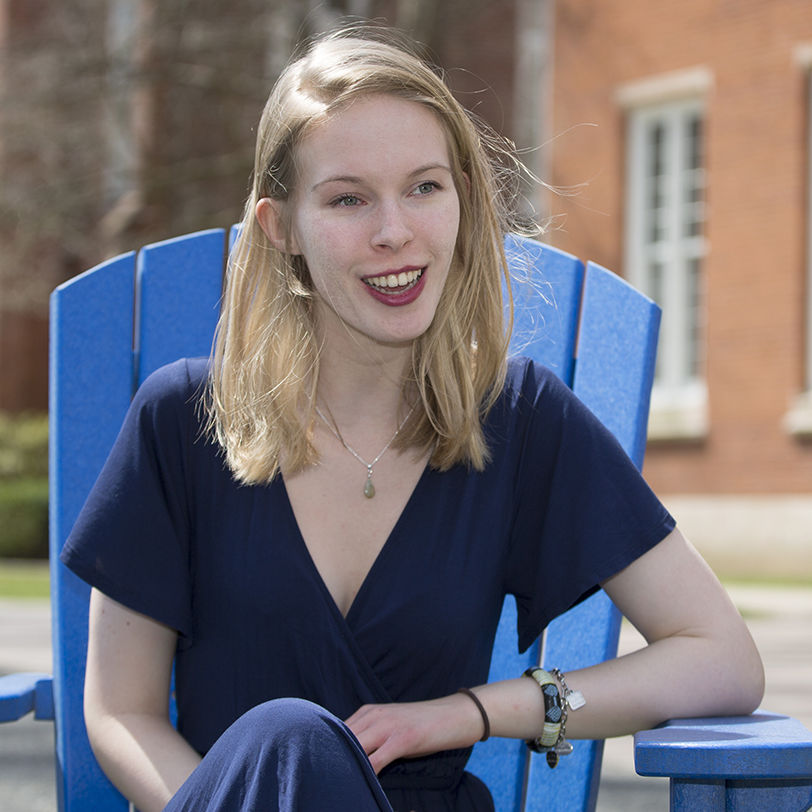
2018 Williamson Medalist Caroline Lawrence
Related Articles
September 30, 2026
Patricia E. Harris '77 to Receive Inaugural Benjamin Franklin Distinguished Innovator Award
This fall, Franklin & Marshall College will debut a new honor and celebrate the career and leadership of one of its most accomplished graduates: Patricia E. Harris '77, Bloomberg Philanthropies CEO, former first deputy mayor of New York City, and Trustee Emerita.
September 28, 2026
Alum’s $1 Million Gift to Construct The Arnold Family Track
For Michael “Mike” Arnold ’08, the track where he competed as a Franklin & Marshall student-athlete reflects the transformative power of Division III athletics programs at scholar-focused institutions — and the kind of lasting impact he hopes to create for future generations of student-athletes.
September 24, 2026
F&M Poll: Economic Concerns Shape Voter Attitudes in Pa. 7th and 10th Districts
The preferences of registered voters living in Pennsylvania’s 7th and 10th Congressional Districts show patterns that are similar to state and national data that favor Democratic candidates, according to the latest Franklin & Marshall College Poll.