
F&M Stories
Penn Medicine Donates AEDs to Enhance Campus Safety at F&M
A donation of four Automated External Defibrillators (AEDs) from Penn Medicine Lancaster General Health has boosted emergency preparedness at Franklin & Marshall College.
Representatives from Penn Medicine visited campus this week to deliver the new AEDs, which will replace and modernize units previously carried in campus safety patrol vehicles. AEDs are portable lifesaving devices designed to analyze a person’s heart rhythm and, when necessary, deliver a controlled electrical shock to help restore a normal heartbeat during sudden cardiac arrest.
The College has 32 AEDs in strategic places across campus, from athletic facilities to academic buildings.
“We are incredibly grateful to Penn Medicine Lancaster General Health for this generous donation,” said Dan Kahler, F&M’s director of environmental health, safety and risk management. “Our campus safety officers are often the first to arrive at the scene of medical emergencies. Equipping every patrol vehicle with a modern AED enhances our ability to provide rapid, potentially lifesaving care while emergency medical services are en route.”
Representatives from Penn Medicine Lancaster General Health visited campus to donate
new AEDs to the College. From left, F&M Chief of Police Jonathan Rosnick, Director
of Environmental Health, Safety and Risk Management Dan Kahler, Penn Medicine EMS
Prevention Manager Andy Rennie, Penn Medicine Executive Director of the Heart and
Vascular Institute Joe Iandolo, and AED Brands Manager April Dubin.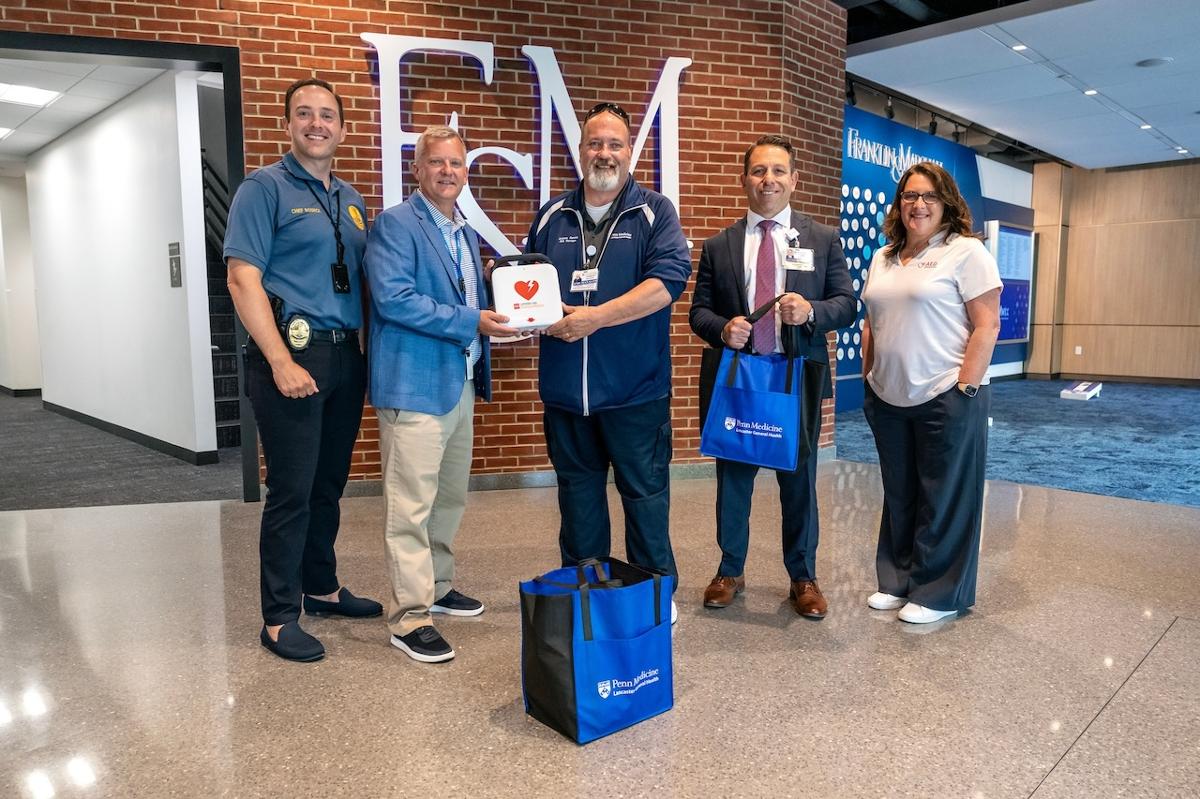
Andy Rennie, Penn Medicine’s EMS prevention, education and outreach manager, said the AEDs will benefit both the College and the surrounding community. The AEDs will be registered with PulsePoint, a free public safety platform that connects people experiencing sudden cardiac arrest with the nearest publicly accessible AED.
“If someone experiences cardiac arrest on Race Avenue, all PulsePoint registrants within a half-mile radius will be alerted,” Rennie said. “The program minimizes the time from the cardiac arrest to emergency services arriving.”
Kahler says the donation reflects the strong partnership between F&M and Penn Medicine Lancaster General Health.
“We have a shared commitment to protecting the health and safety of our campus community,” Kahler said. “We sincerely appreciate Penn Medicine’s generosity and investment in the well-being of our students, faculty, staff, visitors, and guests. Their support ensures that our officers are equipped with the best tools to respond when every second matters.”
Top-Tier Partners in Medicine
At F&M, we take pride in partnering with Lancaster healthcare providers to deliver exceptional resources to students. F&M’s Student Wellness Center, offered through a partnership with Penn Medicine Lancaster General Health, provides high quality healthcare. In addition, partnerships with Lancaster General Health and Lancaster EMS provide students valuable real-world healthcare experience.
Ensuring a Safe and Healthy Campus »Related Articles
September 23, 2026
F&M Joins Project Pericles, Amplifying Community Partnerships in Lancaster
Franklin & Marshall has been selected to join Project Pericles, an honor that underscores the College’s commitment to fostering meaningful impact in its home city of Lancaster.
September 8, 2026
Lancaster Internship Shapes Pre-Law Path
Molly DeBrandt ’28 transformed academic curiosity into career conviction. As an intern with the Office of the Public Defender of Lancaster County, she stepped directly into the daily realities of public defense and discovered a passion for law. “I now intend to apply to law school following my graduation from F&M,” she said.
September 2, 2026
‘I Find It Important and Necessary’: Uncovering Lancaster's Hidden History
For Frances Taylor ’27, the Lancaster Vice project checked all the right boxes: collaborating with a faculty mentor, exploring how their two majors converge in the real world, and unearthing stories the city had forgotten. “I enjoy learning about hidden history that popular culture often overlooks,” Taylor said.