
F&M Stories
Carrying a Torch for Inorganic Chemistry
While his uncle, a sports marketing executive in Milan, was among thousands chosen to carry the Olympic torch to the Milano Cortina Winter Games, Davide Lionetti was in the classroom, enlightening his students about processes of inorganic chemistry.
"I don't know how long they carried a torch for, a few 100 meters per person," the Franklin & Marshall College assistant professor of chemistry says.
Lionetti was raised in the foothills of the Italian Alps. He has spotted family members and friends in the crowds and stands during some of the games' coverage.
"Where they're doing a lot of the events is a place that we all grew up in," he says. "It's the place I grew up skiing."
Lionetti arrived at F&M in fall 2019, but after a semester teaching inorganic chemistry, the pandemic hit and knocked the world off kilter.
"My first couple of years were interesting, let's put it that way," he says.
Lionetti did his undergraduate studies in chemistry at the University of Notre Dame, minoring in medieval studies, and earned his doctorate at the California Institute of Technology.
After three-and-a-half years at the University of Kansas for a postdoctoral fellowship, he chose F&M because "I enjoy working with students more than I enjoy directing a big research program."
Davide Lionetti
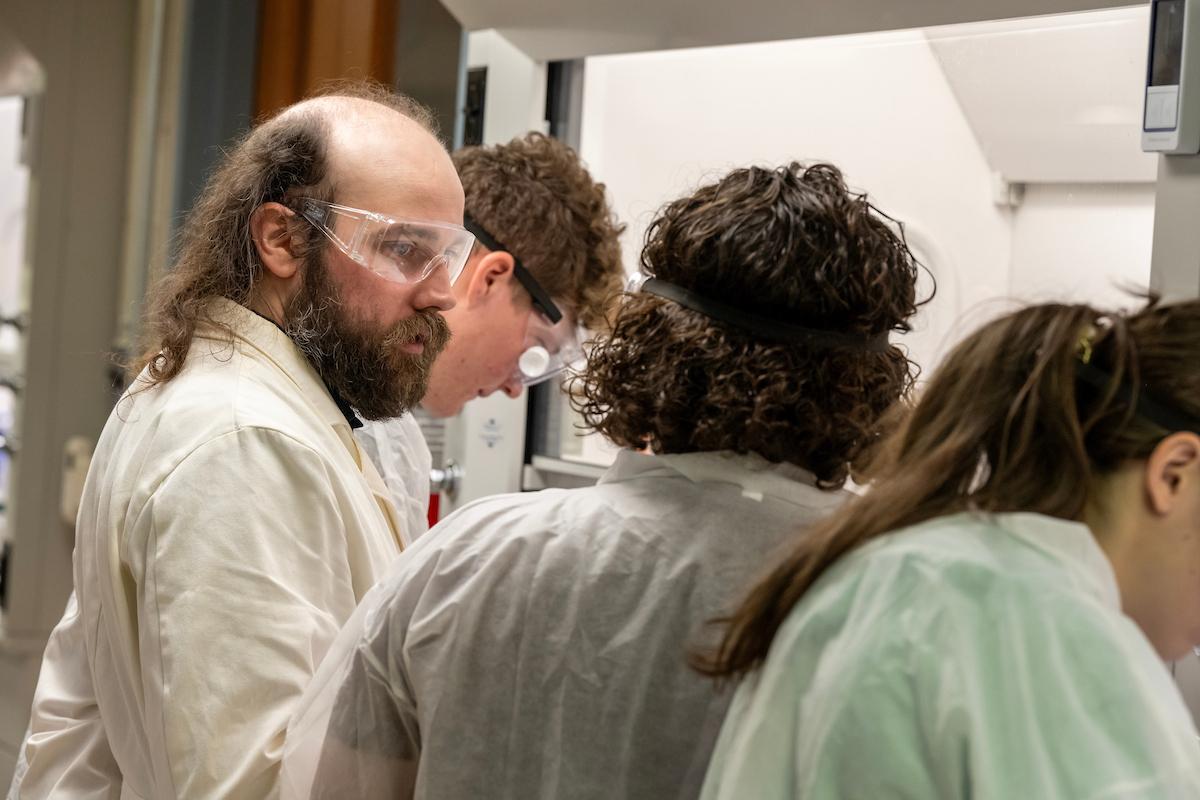
Professor Davide Lionetti working with students in the chemistry teaching lab.
One of the more interesting research projects that he and his students work on in the teaching lab has been a department focus for a few years. It involves making compounds with ruthenium, a brittle white metal that is a valuable catalyst for various chemical reactions.
"After COVID, I redesigned it to be like an open-ended, research-like project where students would come in, prepare some chemical compounds with the metal ruthenium in them, and then propose new ones to make," Lionetti says. "We would change some element of how these compounds are made and see what effect that would have on their properties."
Some of the research carried out by students in his group and in the teaching laboratory, such as senior Julia Fumo '26 and Anthony Micci '24, was published last year in the journal Organometallics.
Lately, when he's not in the lab working with students, Lionetti is watching the Olympics, which is the fourth time Italy has hosted the games (1956, 1960, 2006, 2026).
"This is the first time that the Olympics is actually in a place where I grew up, so I actually know all the places, which is why I didn't think I would get into the Olympics much," he says, "But the fact that it's all the places that I've been at definitely gave it more meaning."
Related Articles
August 31, 2026
Fulfilling a Dream: A Diplomat’s Forensic Internship
For Kayla McCrea ’27, the path to forensic science began with a high school tour of the New Jersey State Police. Emboldened by that early glimpse into the field, she came to F&M to build the expertise and skills necessary to return as a toxicology unit intern — a feat she accomplished this summer.
June 5, 2026
Colin Presby ’06 Brews Up Beverage Career
Being a brewmaster has taken Colin Presby ’06 around the globe – he even oversaw Carnival Cruise line’s first on-board brewery in 2016. He pivoted to an adjacent career in distilling at Mount Hope Winery & Estate, home to the Renaissance Faire.
January 28, 2026
Virtual Cadaver Lab to Redefine & Accelerate Health Professions Training at F&M
Franklin & Marshall College is set to transform its pre-health and science curriculum thanks to a generous grant from the George I. Alden Trust. The funding will support the development of a state-of-the-art virtual cadaver lab, bringing high-tech, immersive anatomical study to F&M’s campus.