
F&M Stories
F&M Senior Develops Music Therapy for Premature Infants
Ania Luckiewicz '20 desperately searched for a way to meld her major and minor — biology and musical performance — when she happened upon a musical therapy that helps infants born prematurely to develop more effectively.
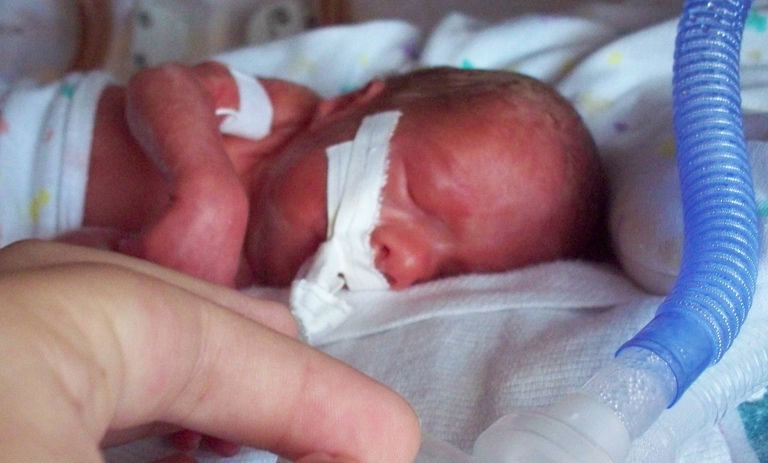
In her sophomore year, when the pre-med student participated in a shadowing program at Lancaster General Hospital, she was inspired by her experience in the neonatal intensive care unit (NICU), which serves infants, known as "preemies," who are born before 37 weeks of gestation.
"I was kind of surprised by the environment of the ward and how abrasive it seemed to little 4-pound babies fighting to survive outside of the nurturing womb they belonged in," Luckiewicz said.
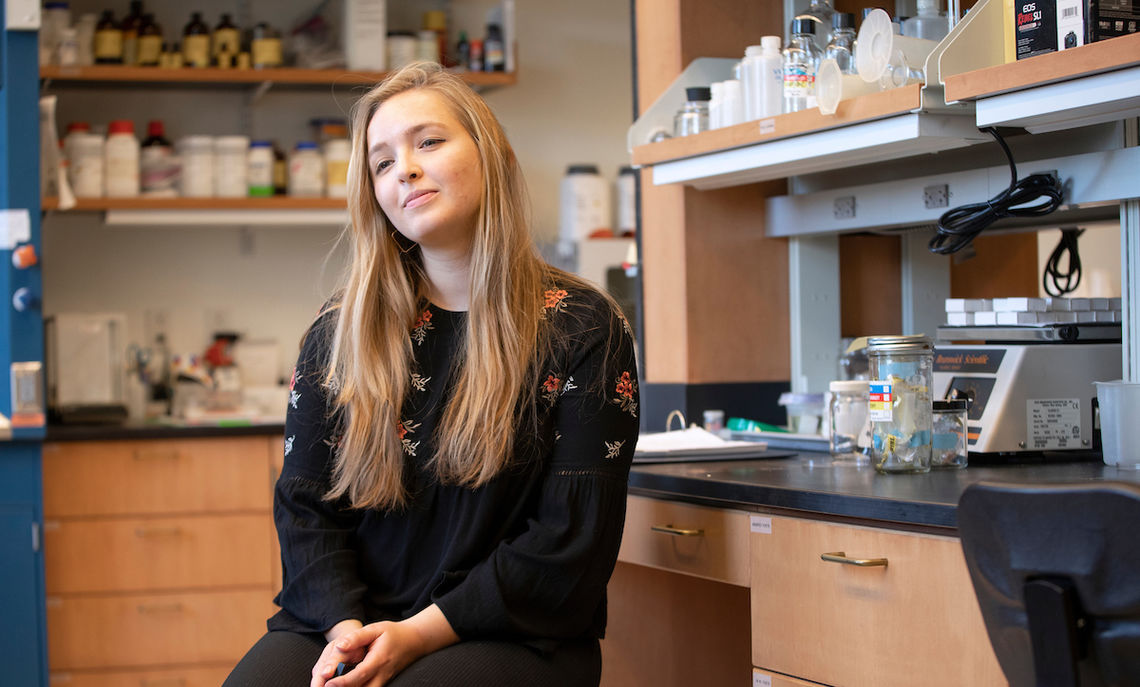
“We start the therapy when the infant reaches 33 weeks gestation, when most are not feeding orally,” she said. “We measure the time it takes for an infant to begin feeding orally — at least 5 percent food intake by mouth — to the time an infant achieves unrestricted oral feedings," said Ania Luckiewicz ’20. Image Credit: Deb Grove
Luckiewicz is a resident of Pittsburgh, where the children's hospital provides music therapy programs for pediatric departments at area hospitals. In 2018, she started to research the subject with Associate Professor of Psychology Krista Casler, director of F&M's Child Development Laboratory.
"I designed a music therapy project," she said. "A study conducted in 2013 used different sounds to benefit the baby in different ways, and then I started to research how a NICU worked and the babies' feeding schedule."
Luckiewicz pushed her project for a field study, an ambition Casler thought doubtful because of rigorous requirements hospital boards demand. F&M's psychology researchers have difficulty enough getting into local schools to study developing children.
"To get access to such a vulnerable population, the chances are miniscule," said Casler, the department chair. "I told her, 'Let's at least do the research, write it up as a proposal, maybe you take it with you to a graduate program.'"
Luckiewicz, whose parents practice medicine, completed the research and approached one area hospital after another with little luck but plenty of perseverance. As Casler recalled, "I thought we were done, but she kept knocking on doors."
In the middle of last summer, Casler received a simple message from Luckiewicz: "I'm in."
At York Hospital, with the support of two of the hospital's neonatologists, Luckiewicz went before the hospital's Institutional Review Board, fielded many questions, and asked them to give her project a chance. They did.
"We rewrote my protocol to something more feasible and I presented that to the board," she said. "I explained the project, the benefits, the risks, of which there weren't many, and how this could potentially help, and why it's a good idea to allow me to do this study."
Just as important, Luckiewicz convinced the preemies' parents, who do not know whether their infant is in the control group. "The parents were excited about the project," she said.
The therapy's primary objective is to improve maturation of the infants' oral feeding behavior, to get them off feeding tubes faster and more efficiently.
"We start the therapy when the infant reaches 33 weeks gestation, when most are not feeding orally," she said. "We measure the time it takes for an infant to begin feeding orally -- at least 5 percent food intake by mouth — to the time an infant achieves unrestricted oral feedings."
Feeding is an indicator of overall general health. Luckiewicz hopes the therapy combats the effect of unnecessary stress and promotes healthy development through a directed noise environment.
Sounds include simulation of a relaxed woman's heartbeat to improve sucking ability, a harp lullaby to slow infant heart rate and improve activity level, and simulation of a relaxed woman's breath rate to improve oxygen saturation and sleep quality.
Luckiewicz determined proper decibel level and sounds, then gave the NICU nurses MP3 players that they placed in the infant's bed. No adverse effects have been reported.
"The nurses are instructed to turn the music on for a three-hour period: once during the day and once at night for two weeks," she said. Each therapy period begins during a feeding. Vitals are recorded throughout this period.
According to Casler, "There are now multiple hospitals saying, 'Actually, we'd be interested in running this, too.' It's potentially becoming a multisite clinical trial to run Ania's project." The study recently expanded to Lancaster General's Women & Babies Hospital, where the nurses are training this month on the protocol.
Luckiewicz's project will study 120 infants over two years. Two other seniors, Alyssa Martin and Sonia Hafiz, are assisting in collecting data this spring. Meanwhile, Luckiewicz isn't sure what she wants to study in medical school.
"I have developed a liking for neonatology because of this study," she said. "It's really cool, but I think I haven't been exposed to enough field medicine to know what I want to do yet."
Related Articles
October 13, 2026
She Asked. A Diplomat Answered.
Teagan Durkin ’26 believes the key to networking is simple: Be bold and talk to people. That philosophy helped her utilize the Franklin & Marshall College alumni network and land her first job after graduation.
October 6, 2026
Former Lancaster Mayor to Serve as Inaugural Leader-in-Residence at Mehlman Institute
Danene Sorace, who served as Lancaster's 43rd mayor from 2018-2026, has been named the inaugural leader-in-residence at F&M’s Mehlman Leadership and Performance Institute. During the 2026-27 academic year, she will work with the Institute’s 60 Mehlman Fellows, bringing her experience in civic leadership and public service directly to the F&M community.
September 30, 2026
Patricia E. Harris '77 to Receive Inaugural Benjamin Franklin Distinguished Innovator Award
This fall, Franklin & Marshall College will debut a new honor and celebrate the career and leadership of one of its most accomplished graduates: Patricia E. Harris '77, Bloomberg Philanthropies CEO, former first deputy mayor of New York City, and Trustee Emerita.