
F&M Stories
Students Uncover Lancaster's Secret Side
With its bucolic landscape and Amish roots, many visitors to Lancaster assume the region’s past is nothing less than virtuous. But a group of Franklin & Marshall College students is uncovering a more salacious side.
“It’s a common misconception that Lancaster was always a conservative, sleepy little city,” said rising senior Jillian Barger, of Blairsville, Pa.
Addressing a crowd on the steps of St. James Episcopal Church in downtown Lancaster, Barger begins her shift as a tour guide of Lancaster Vice History.
The tour and ongoing research is facilitated by Alison Kibler, professor of American studies and women's, gender & sexuality studies.
The tour begins on the steps of St. James Episcopal Church in downtown Lancaster.
(Photo by Deb Grove)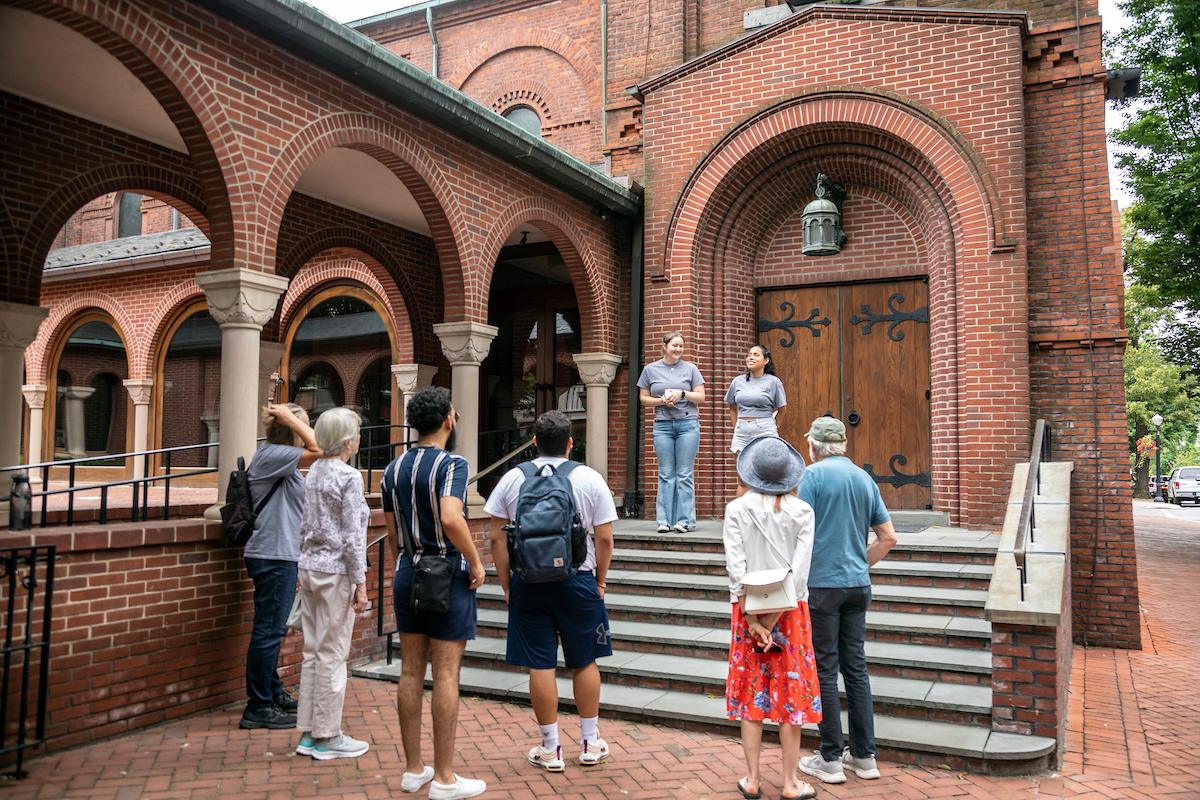
Lancaster City, 1913-1918
The year is 1913, and a reform movement is growing in downtown Lancaster.
Galvanized by religious leader Rev. Clifford Twombly, a local group called the Law & Order Society has partnered with national reform groups to investigate vice in the city.
What is vice?
“The definition of vice in 1900 was prostitution*, gambling and liquor violations,” said Jayden LaCoe, a rising junior from Wellsboro, Pa.
Walking a tour group to hotels, restaurants and row houses where vice activities transpired downtown, LaCoe and Barger discuss relevant research into America’s progressive era, a time of intense social and political reform.
Posing as traveling salesmen or couples from out of town, investigators from the American Social Hygiene Association talked to 1900s commercial sex workers and madams (brothel leaders) in Lancaster to gather an account of vice in the city.
The resulting report, published in 1914, claimed that investigators found 189 sex workers at 53 different bawdy houses (brothels) throughout the city.
Census records, news clippings and investigator notes uncovered by F&M students reveal misguided efforts to address commercial sex work in the early 20th century.
The campaign did not stop vice in the city, but drove it further underground.
“They simply moved to other venues,” LaCoe said.
Maria Leon Reyes '23 guides a tour of Lancaster Vice History. (Photo by Deb Grove)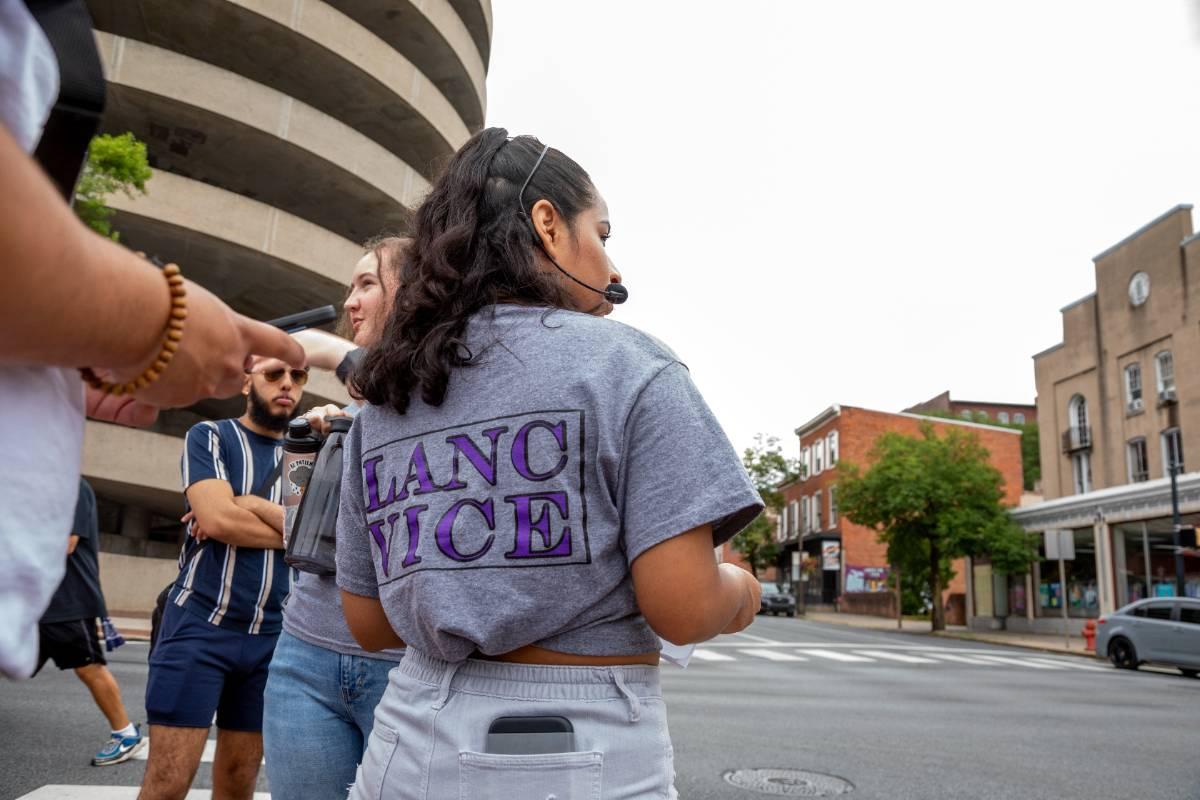
Harwood Commons patio at F&M, July 2022
LaCoe and Barger are joined by rising seniors Maria Leon Reyes and Lauren Sphar to debrief a busy week of vice history tours.
The students share their hopes for the project’s future, including a website to house notes and archival information. They’ve even pitched the tour idea to area historical societies.
“We hand-typed the cursive writing from the notes of an investigator who walked around Lancaster for a couple of years,” said Sphar, of Fort Worth, Texas.
A double major in American studies and English literature, Sphar has always been drawn to certain aspects of history, “but I never thought that I would be so invested in the 1910s,” she said with a laugh.
For Leon Reyes, the research has complemented her major in sociology and government and minor in women's, gender & sexuality studies.
“My ultimate goal is to spread education,” said Leon Reyes, of Orlando, Fla.
She explained that vice reform programs did not address the roots of social problems, but rather, perpetuated inequalities.
“There are pressing issues that continue on to this day, especially within the criminal-justice system,” Leon Reyes said. “You want to say that ‘Things in the past are in the past.’ But history tends to repeat itself, even when you don't address it.”
A group of F&M students is researching 1900s reform group efforts to curb prostitution,
gambling and liquor law violations in downtown Lancaster. (Photo by Deb Grove)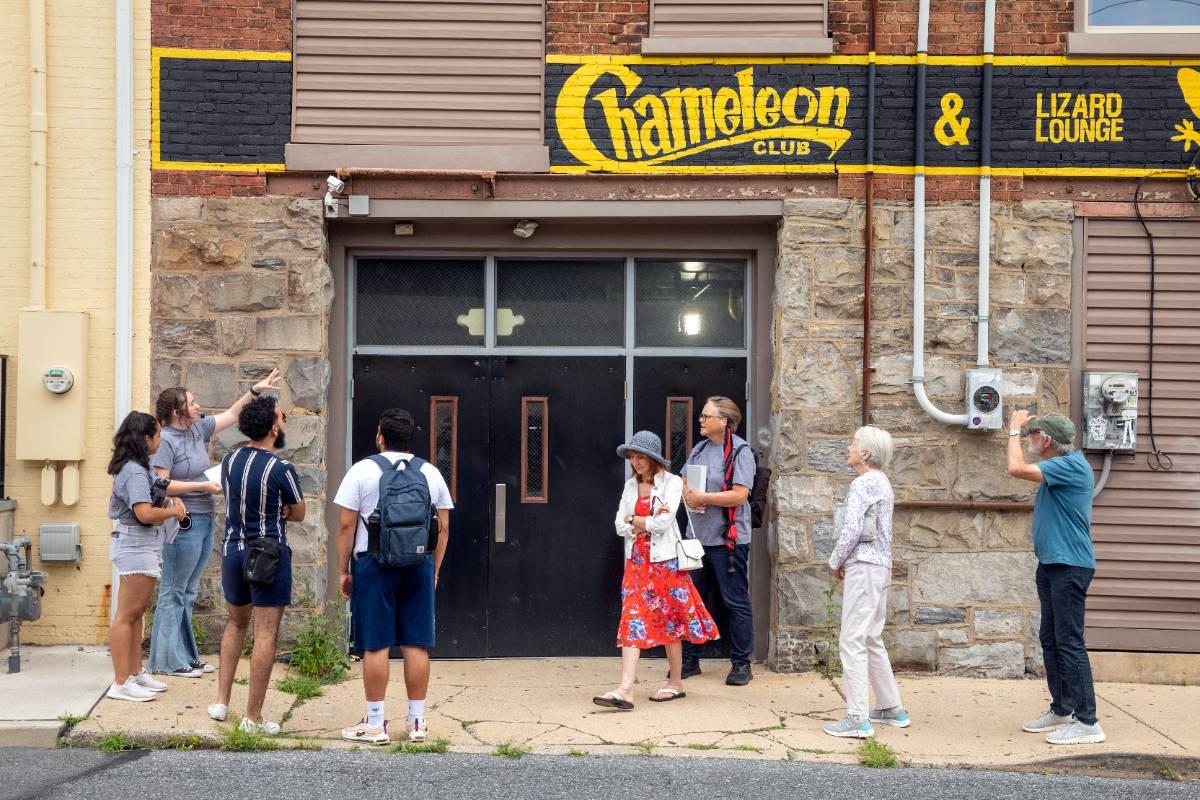
Related Articles
October 6, 2026
Former Lancaster Mayor to Serve as Inaugural Leader-in-Residence at Mehlman Institute
Danene Sorace, who served as Lancaster's 43rd mayor from 2018-2026, has been named the inaugural leader-in-residence at F&M’s Mehlman Leadership and Performance Institute. During the 2026-27 academic year, she will work with the Institute’s 60 Mehlman Fellows, bringing her experience in civic leadership and public service directly to the F&M community.
September 30, 2026
Patricia E. Harris '77 to Receive Inaugural Benjamin Franklin Distinguished Innovator Award
This fall, Franklin & Marshall College will debut a new honor and celebrate the career and leadership of one of its most accomplished graduates: Patricia E. Harris '77, Bloomberg Philanthropies CEO, former first deputy mayor of New York City, and Trustee Emerita.
September 28, 2026
Alum’s $1 Million Gift to Construct The Arnold Family Track
For Michael “Mike” Arnold ’08, the track where he competed as a Franklin & Marshall student-athlete reflects the transformative power of Division III athletics programs at scholar-focused institutions — and the kind of lasting impact he hopes to create for future generations of student-athletes.