
F&M Stories
Striking the Right Chord
Award-winning songwriter Bruce Sussman ’71 founded Franklin & Marshall’s first a cappella group on a whim in 1968. As the ensemble plans for a 60th anniversary celebration, alumni and current members reflect on the group’s origins and influence.
Like any good legend, the origins of Franklin & Marshall College’s longest-standing a cappella group are a bit surreptitious.
"Everything about The Poor Richards was illegal," jokes Bruce Sussman ’71, who founded the ensemble as a sophomore.
In fall 1968, Sussman intercepted a letter addressed to the glee club inviting F&M to Goucher College’s annual a cappella showcase. He replied back with a resounding ‘yes.’ The only problem? There was no a cappella group at F&M—yet.
"There were no Whiffenpoofs like Yale. No Harvard Krokodiloes. No Colgate Thirteen. No Princeton Tigertones," he said. "And then, this letter from Goucher came, and I seized the opportunity. That was the launching pad."
As for the singing troupe’s name? The idea hit like a bolt of lightning, inspired by College namesake Benjamin Franklin’s long-running publication, the "Poor Richard’s Almanack."
"My best ideas come fast," Sussman said.
"Everything about The Poor Richards was illegal."
Creativity is a trait that has served him well. An accomplished lyricist and librettist, Sussman is widely known for his work with long-time collaborator, Barry Manilow. The pair wrote more than 200 songs for numerous recording artists, films, stage musicals and television programs. Their 1978 hit, "Copacabana (At the Copa)," earned Sussman his first gold record and Grammy Award.
With just three months to prepare for the Goucher singing showcase, Sussman concocted a plan for F&M’s 14-man crew to rank against the lineup of established a cappella ensembles.
"My idea was, ‘We should be funny, we should move on stage and we should have some piano accompaniment,’" he recalled.
Playfully defying tuxedo tails and crested college blazers, The Poor Richards took the stage wearing jeans, tie-dye shirts and bandanas.
Their opener – an arrangement of 1920s hit "Ain’t She Sweet" – was a resounding success.
"Halfway through, we started dancing. The house just fell apart. They thought it was hilarious," Sussman said.
It wasn’t until 1970 that The Poor Richards performed for an F&M audience during a Parents Weekend. When the College went co-ed in 1969, the group expanded. "We hit our stride when we added women," Sussman said.
Much like The Poor Richards, Sussman’s career in music almost never happened. "I was supposed to be a lawyer," he said. "I had great grades, but I was not happy." On a whim, he took several music electives and a Shakespeare survey in his sophomore year. "My lights got lit. I just loved them," he said.
Rather than transfer to a music conservatory, Sussman worked with the late Hugh Gault – a "titanic force" in his life – to resurrect discontinued music classes. While Sussman graduated with a degree in English, his music education was enough to launch a successful career in the field. (Music wasn’t introduced as a major at F&M until the 1980’s).
On another serendipitous note, Sussman became connected to established composer and lyricist Stephen Sondheim through a musicianship course taught by Gault. Sondheim soon became a mentor and friend. (Sondheim also collaborated with playwright James Lapine ’71. Though acquainted as classmates, Lapine and Sussman never worked together professionally).
A program from The Poor Richards' inaugural concert at Goucher College’s annual a
cappella showcase in 1969.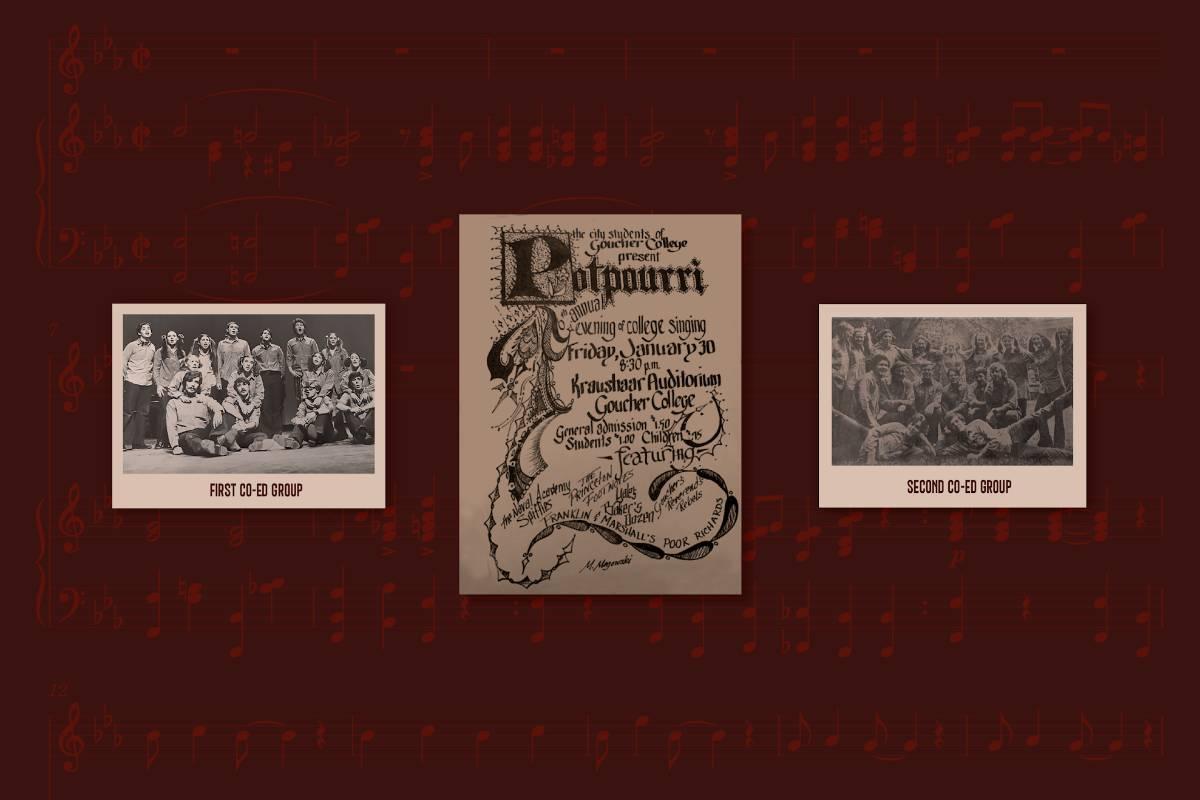
After 25 years of songwriting, Sussman and Manilow set their sights on Broadway.
"Harmony" – their first full-scale stage script – is based on the true story of a German-Jewish comedy sextet’s success halted by Hitler's rise to power. USA TODAY called it "the most promising musical for 1998."
Sussman finally checked Broadway off his bucket list when Harmony debuted at Manhattan’s Ethel Barrymore Theatre in 2023.
"Broadway had been elusive to me," Sussman said. "My score for Harmony is my proudest hour."
It’s fitting that Sussman’s production company – Appoggiatura Music – is named after an embellishing note indicating a moment of departure from a composition’s expected harmony.
From launching F&M’s first a cappella group to a storied career in music, his journey has been anything but predictable. The Poor Richards helped mark the start of that legacy.
“It sure has survived, and I’m delighted to have made that contribution,” Sussman said.
Seasons of Love
Fifty-seven years later — and in the same room where Sussman once rehearsed — F&M junior Esther Burlington ’27 taps her fingers on the studio’s piano to keep tempo at an October rehearsal. Co-president of The Poor Richards (often referred to as "PR" in recent years), she auditioned as a first-year student and hasn’t looked back.
"The group is very tight-knit. It’s your friends, your family. PR is the thing you look forward to. It’s not like another class or another task," Burlington said.
Currently at 12 members (including some studying abroad), the group gathers three times a week to rehearse in Room B-11 — a space that visiting alumni still ask to visit — in the depths of Steinman College Center. Room B-11 meant so much to Ed Chung ’97 that he named his New York City recording business after it. A member of The Poor Richards during all four years at F&M, Chung met his wife, Abbey Janes ’00, through the group. He founded B-11 Entertainment in 2002.
"I fell in love with the camaraderie of being in a singing group in particular," he said. Chung has returned to campus over the years to help produce albums, most recently in 2023.
Room B-11 meant so much to Ed Chung ’97 that he named his New York City recording
business after it. (Photo by Deb Grove)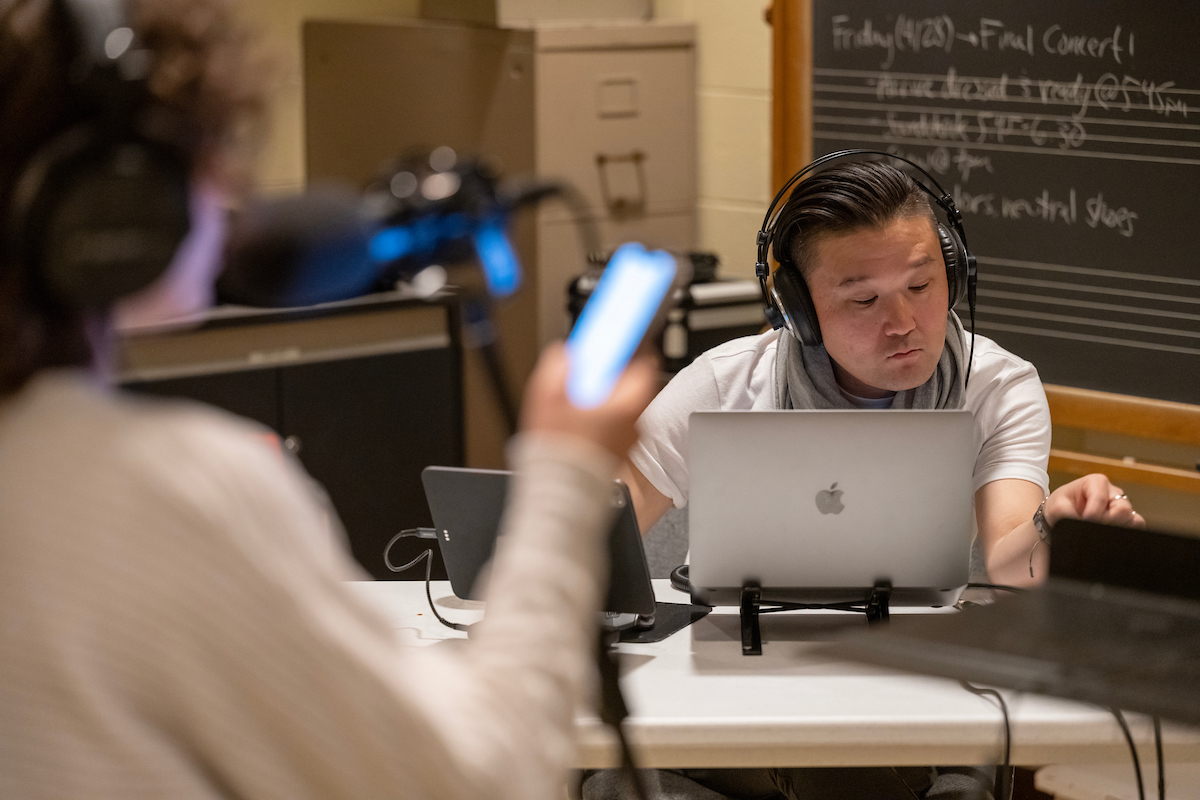
That particular recording was facilitated by Liz Joslin ’24, former president of The Poor Richards. Now working in politics, Joslin is a driving force behind an upcoming 60-year reunion.
"Anytime Poor Richards alumni meet or come together, it's like you always knew each other," she said.
On April 27, 45 alumni members of the ensemble convened on campus for a nostalgic gathering of singers from past and present. They no longer don tie-dye and denim; the dress code in recent years calls for red and black attire. "We had a graduate from 1969 and a graduate from 2024 there. It was truly generations of Poor Richards alumni," Joslin said.
While few of the attendees pursued musical careers beyond college, a cappella "was the most important part of their belonging at F&M," Joslin said.
Alumni gathered to rehearse for a special occasion: Performing a song at Almanack, The Poor Richards’ end-of-semester concert. Singing "Seasons of Love" from the 1996 Broadway musical "Rent," alumni shared the stage with students and hit every note after just one day of practice.
As The Poor Richards approach 60 years on campus, melodic Diplomats such as Burlington, Joslin, Chung and Sussman hope to bring even more alumni together for their most memorable reunion yet.
"I think it really is the epitome of the small liberal arts experience,” Joslin said.
Caroline Miller contributed to this story.
"Anytime Poor Richards alumni meet or come together, it's like you always knew each
other," said Liz Joslin ’24, shown singing in a Dec. 2023 concert. (Photo by Deb Grove)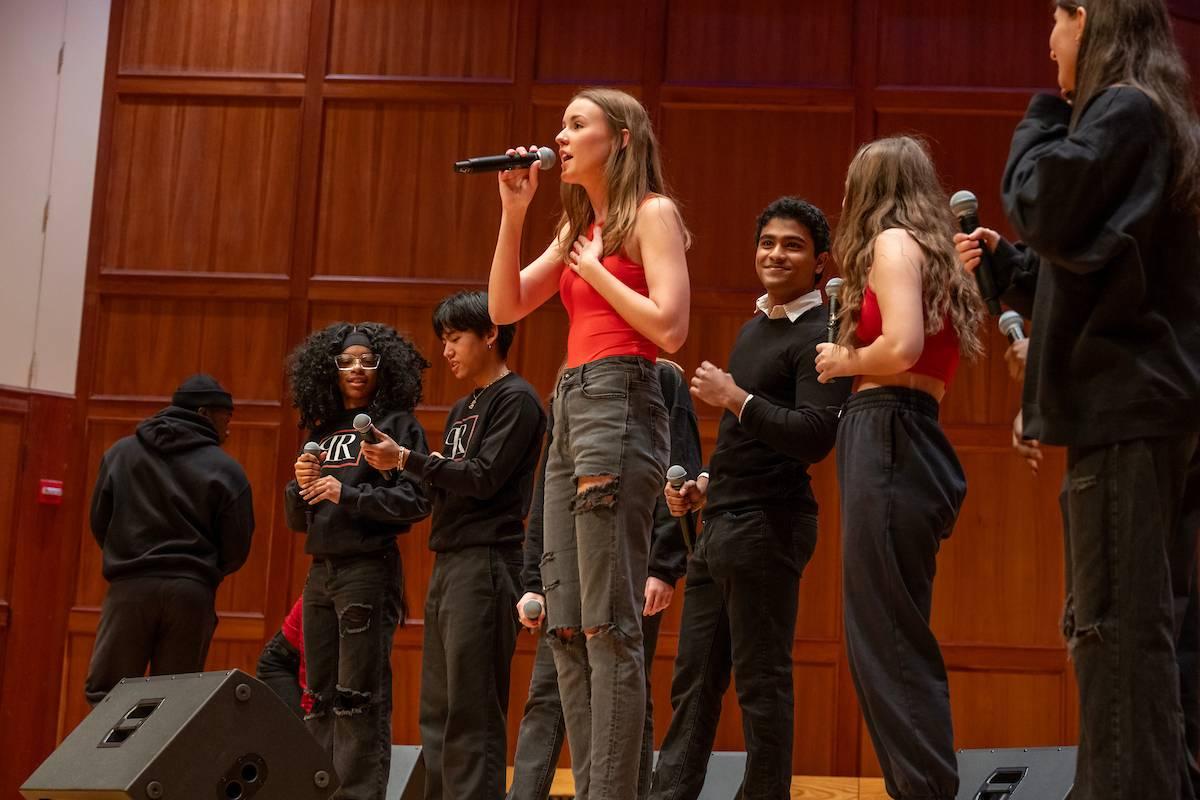
A Cappella on College Avenue
Italian for "in the style of the chapel," a cappella music was originally worship-focused but has broadly expanded to vocal arrangements with no instrumental accompaniment. Enduring music’s many iterations over time – from barbershop quartet crooners to modern-day beatboxing – a cappella ensembles have become a staple on many college campuses. Franklin & Marshall is home to four of these groups:
The Poor Richards: A coed a cappella group founded in 1968; one of the oldest continuously operating student groups on campus
The Chessmen: An all-male a cappella group founded in 1989
Sweet Ophelia: An all-female a cappella group
Kite & Keys: A group for women and gender minorities and the most recent addition to F&M's lineup of a cappella groups
Related Articles
September 30, 2026
Patricia E. Harris '77 to Receive Inaugural Benjamin Franklin Distinguished Innovator Award
This fall, Franklin & Marshall College will debut a new honor and celebrate the career and leadership of one of its most accomplished graduates: Patricia E. Harris '77, Bloomberg Philanthropies CEO, former first deputy mayor of New York City, and Trustee Emerita.
September 28, 2026
Alum’s $1 Million Gift to Construct The Arnold Family Track
For Michael “Mike” Arnold ’08, the track where he competed as a Franklin & Marshall student-athlete reflects the transformative power of Division III athletics programs at scholar-focused institutions — and the kind of lasting impact he hopes to create for future generations of student-athletes.
September 10, 2026
‘I Wanted to Learn More”: From a Campus Connection to Career Opportunity
For Gonzalo Gentou Arbizu ’26, a brief introduction to a fellow Franklin & Marshall College Diplomat grew into months of conversations about travel, career possibilities, and life after college. Now it has led to his first full-time job.