
F&M Stories
Student’s Research Investigates World War II Mission in Germany
History and archaeology are Franklin & Marshall senior Gavin Vogel's twin studies of interest, and for six weeks this summer, he found himself immersed in both.
In Germany's Black Forest, Vogel worked with an archaeological research team, uncovering wreckage and possible remains from an American B-17G Flying Fortress, a nine-crew member bomber that crashed there in 1944.
"I thought it was a great research project because we worked with the DPAA (Defense POW/MIA Accounting Agency) on a recovery mission, trying to find American airmen," Vogel says.
More than 72,000 Americans who served in World War II remain unaccounted for, including many in Europe, according to DPAA.
"DPAA does a number of missions every year," the history and anthropology joint major says. "This summer they were doing a mission in Italy to find downed airmen, we had our mission in Germany, and there were missions in Vietnam."
Two Indiana University of Pennsylvania anthropology professors led the research team of 14 students from various universities. Vogel was F&M's sole student. The work entailed using ground-penetrating radar to locate artifacts and setting up an archaeological survey of the area.
"We did some digging," he says. "We were lucky enough to work with some residents, the former state archaeologist who provided us with key and pivotal details about the crash, and a couple of foresters who worked in the forest–their metal detector helped us locate where to dig."
Gavin Vogel helping excavate WWII crash site.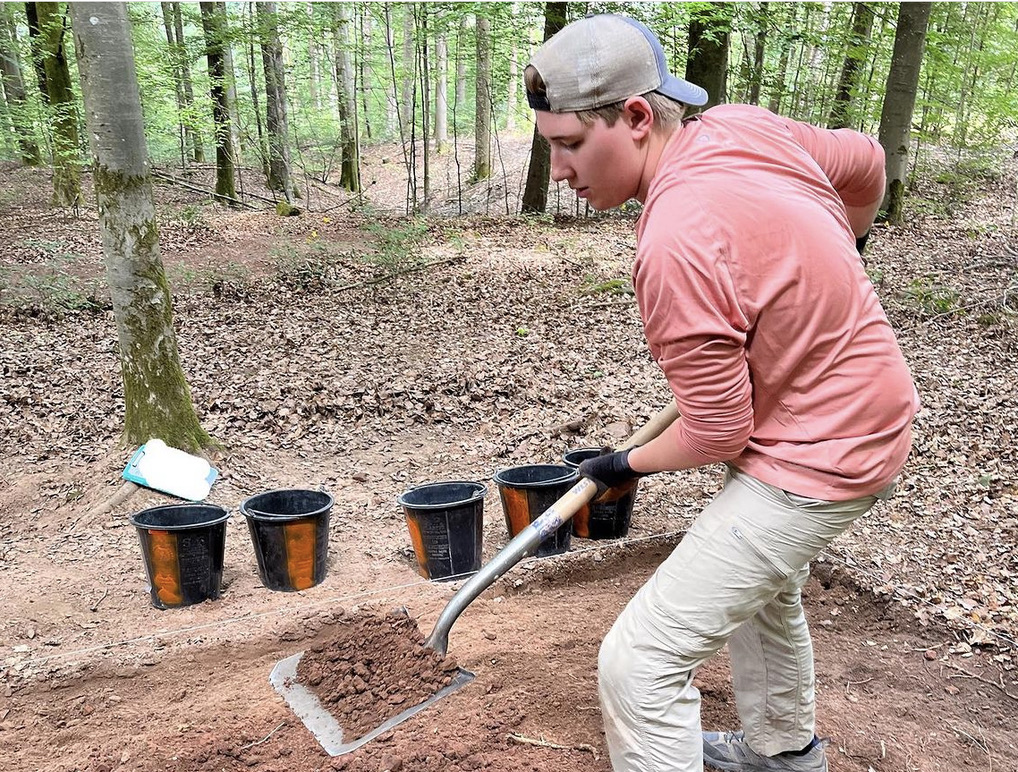
The research team also studied data from a past excavation to help them determine where to dig. While the team's excavation was successful, information about exactly what was discovered is confidential.
"We were told not to say anything until information was released," he says.
Vogel discovered the summer research project on the American Anthropology Association website.
"It was right up my alley," he says. "I absolutely love studying the world wars, the 20th century, and the evolution of technology between the two world wars.”
Although the work was hard and the days long, Vogel says he's found his life's passion.
“I knew it would be a lot of work. It was a lot of work, and I didn’t think I would enjoy it at all, but I’m now looking at employment opportunities with the DPAA," he says. "I got a lot of recommendations about what to do next just by talking to the TAs (teaching assistants), professors and F&M advisers."
Related Articles
October 13, 2026
She Asked. A Diplomat Answered.
Teagan Durkin ’26 believes the key to networking is simple: Be bold and talk to people. That philosophy helped her utilize the Franklin & Marshall College alumni network and land her first job after graduation.
September 2, 2026
‘I Find It Important and Necessary’: Uncovering Lancaster's Hidden History
For Frances Taylor ’27, the Lancaster Vice project checked all the right boxes: collaborating with a faculty mentor, exploring how their two majors converge in the real world, and unearthing stories the city had forgotten. “I enjoy learning about hidden history that popular culture often overlooks,” Taylor said.
August 28, 2026
Building the Impossible: An F&M Alum’s Mission to Create the World’s Fastest Aircraft
As chief executive officer of high-speed aircraft company Hermeus, Zach Shore ’06 leads the effort to push the boundaries of what’s possible by building the world’s fastest autonomous aircraft.