
F&M Stories
Starstruck in the Land of the Rising Sun
A Diplomat's influence reaches everywhere — even the skies of Japan. This summer, a handful of astrophysics majors and their professor enjoyed a two-week trip to Japan that was “part pulsar science expedition, part cultural exchange related to the NANOStars program at F&M," says Fronefield Crawford, Charles A. Dana Professor of Physics and Astronomy.
The trip, which was supported by a National Science Foundation grant, was "an opportunity for the F&M students to engage with Japanese students conducting similar research at Kumamoto University,” said Crawford, head of the gravitational wave-detecting program at F&M and the director of F&M’s Grundy Observatory.
Off-campus study experiences like these aren’t simply time away from campus; they’re meaningfully woven into the entire F&M academic journey. The students — Tai Jespersen '26, Adeon Muyskens '26, Volkan Turan '27, Haunah Thomas '27, and alumna Melanie Ficarra '24 — spent the fortnight abroad converting classroom theory into hands-on practice, all while building valuable connections with their international peers.
"I had the opportunity to meet with Japanese students working in various fields and learn about their research as I made connections from all over the world," said Turan, a double major in astrophysics and computer science from Istanbul.
Turan, who is also a Japanese minor, said he had the chance to communicate with the students and local people in their language.
"Both helped me improve my Japanese skills and helped me to connect with them on a deeper level," he said.
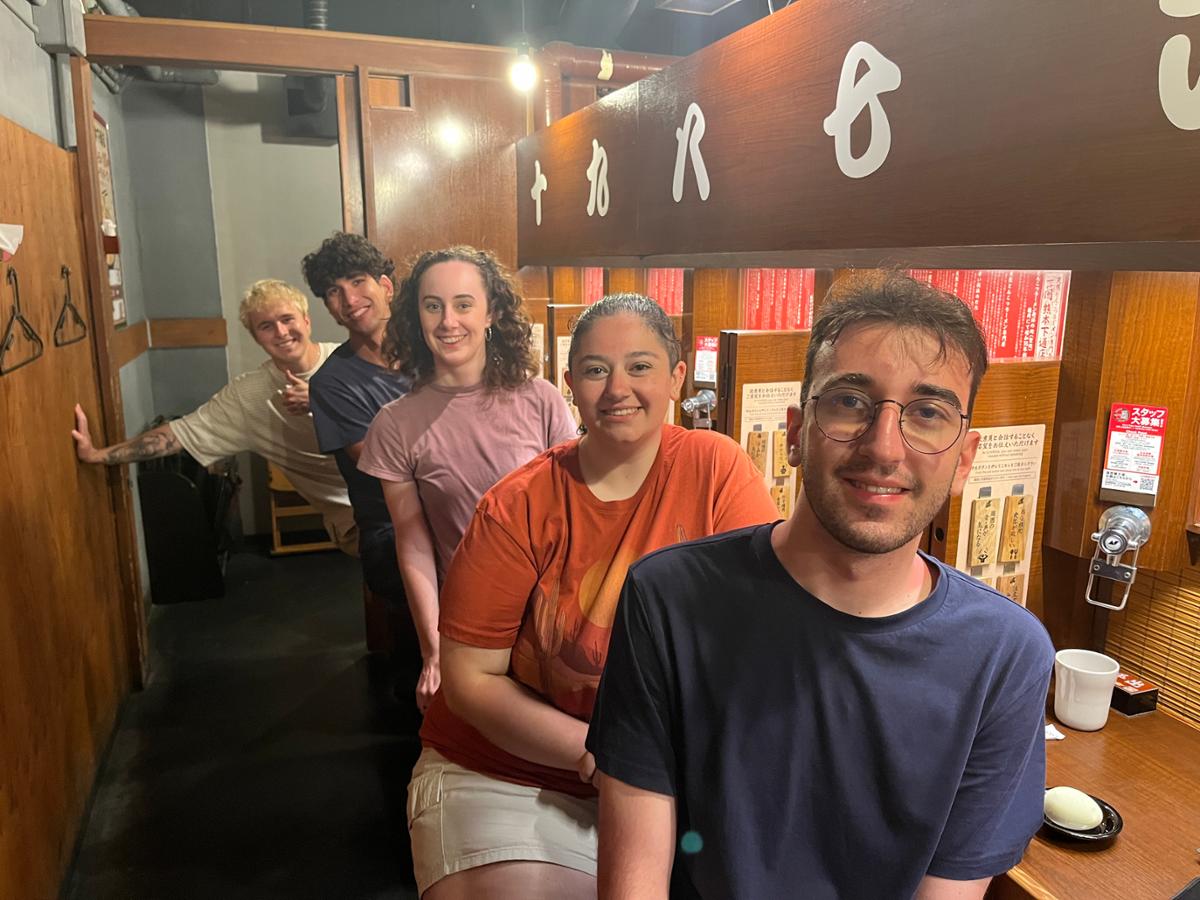
F&M astrophysics students — Adeon Muyskens '26, Tai Jespersen '26, Haunah Thomas '27, alumna Melanie Ficarra '24, and Volkan Turan '27 — spent a fortnight abroad in Japan at Kumamoto University converting classroom theory into hands-on practice.
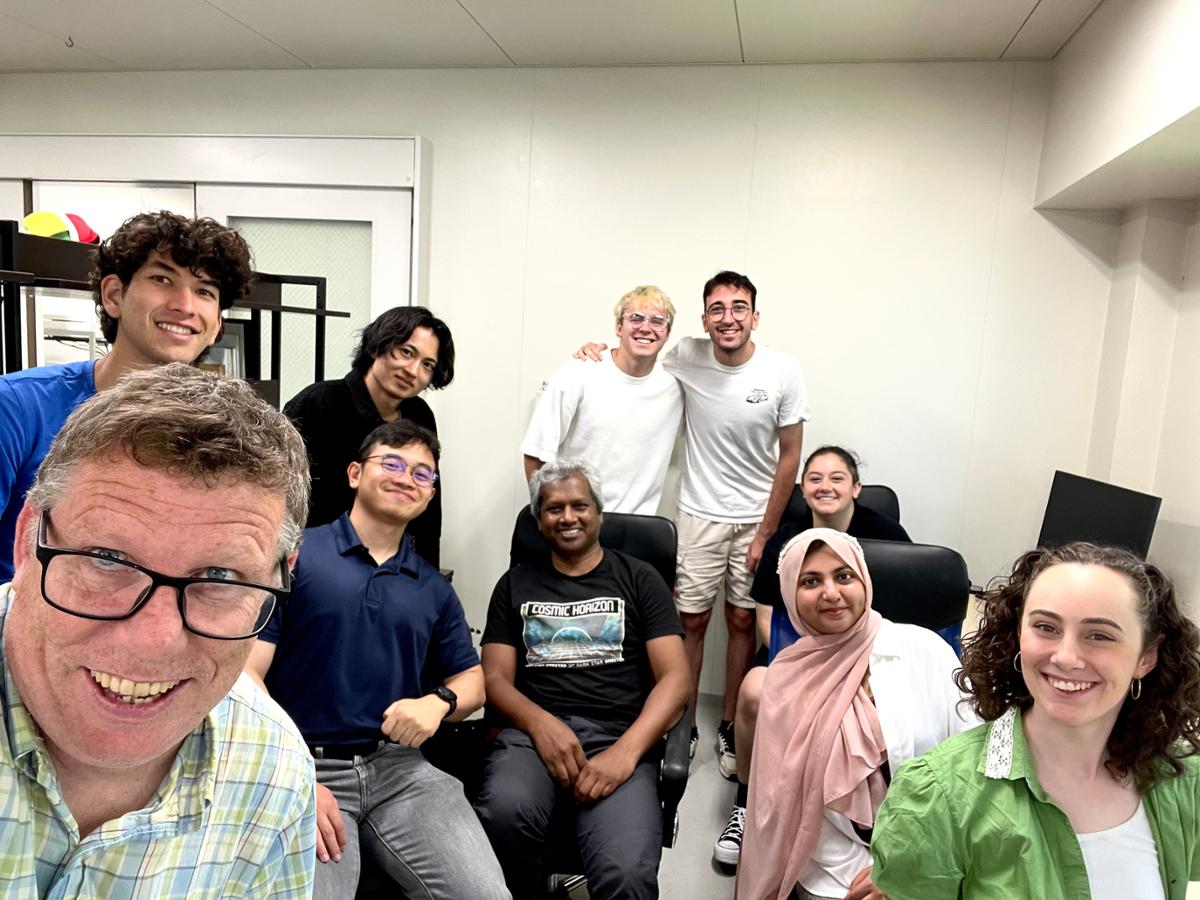
Fronefield Crawford, Charles A. Dana Professor of Physics and Astronomy, with Tai Jespersen '26, Adeon Muyskens '26, Volkan Turan '27, alumna Melanie Ficarra '24, Haunah Thomas '27, and colleagues from Kumamoto University.
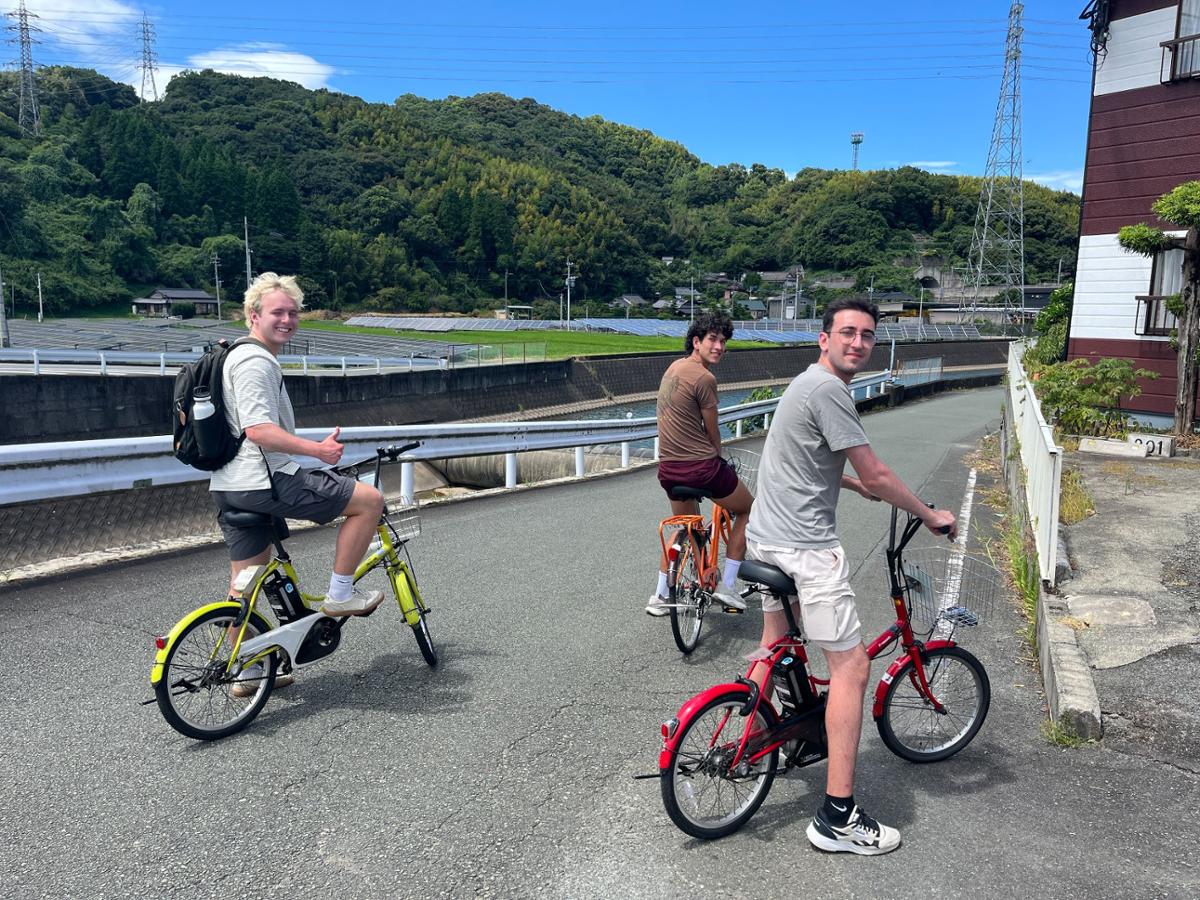
While they were in Kumamoto, a city on the island of Kyushu in the southern part of Japan, the students toured a medieval castle; took a 15-mile bike ride along rail trails outside the city; visited Mount Aso, an active volcano; and went swimming with the locals in a river.
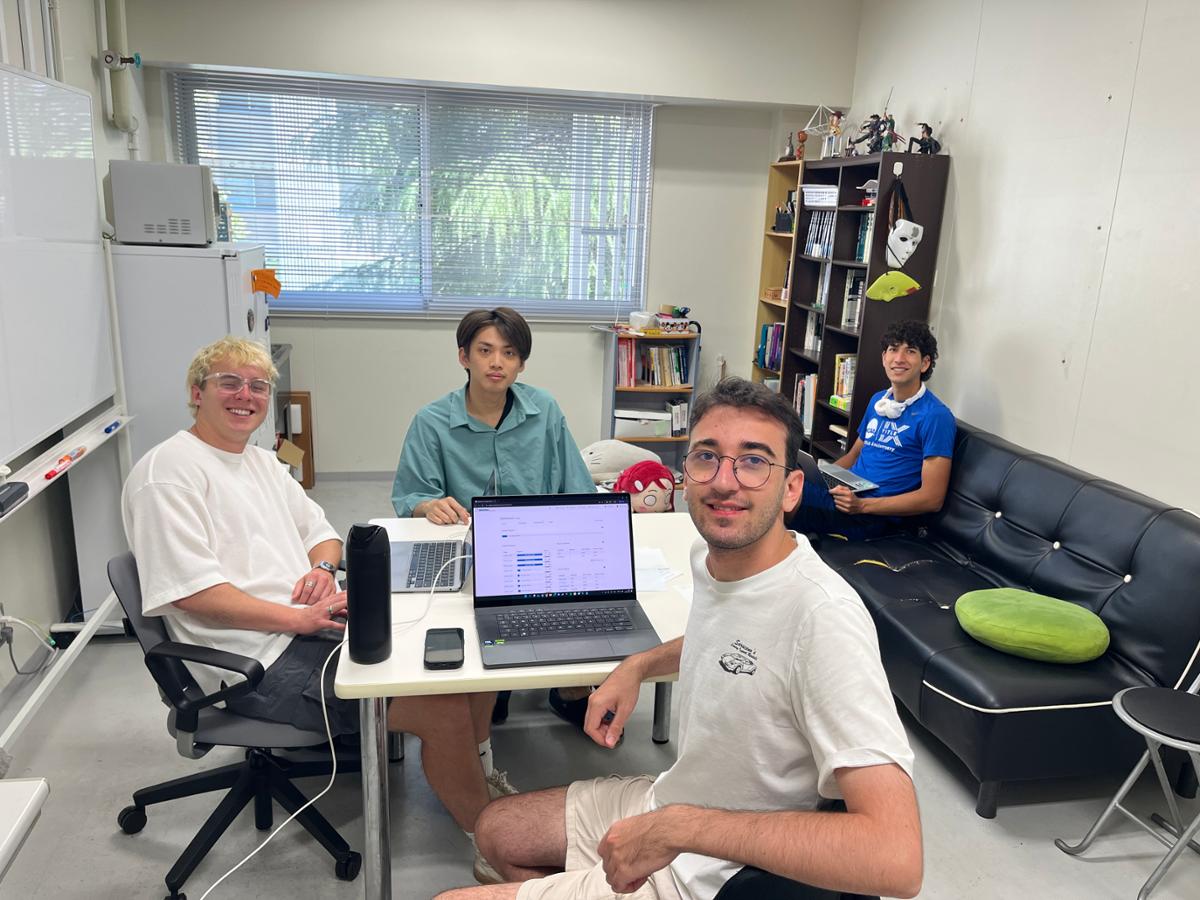
Adeon Muyskens '26, Volkan Turan '27, and Tai Jespersen '26 worked with Ryo, a Kumamoto University undergraduate student. Turan (center), who is also a Japanese minor, said he had the chance to communicate with the students and local people in their language. "Both helped me improve my Japanese skills and helped me to connect with them on a deeper level," he said.
Pulsars are spinning neutron stars that emit a beam of radio waves as they spin, which we detect with radio telescopes as a series of regular pulses. The students collaborated to search a data set for very slow spinning pulsars in a clump of nearby galaxies known as the Magellanic Clouds, install software to search for extraterrestrial signals in a pulsar data set, search for dark matter signatures in pulsar data, and search for highly accelerated binary pulsars orbiting massive stellar companions, such as black holes.
"I was introduced to parts of the research process for our pulsar projects that were previously unknown to me," said Thomas, a double major in astrophysics and English. "I now have a better understanding of, and deeper involvement in, that process."
Muyskens agreed, adding that the experience solidified his post-graduate aspirations.
"Doing research at Kumamoto University exposed me to new scientific approaches and perspectives, and reaffirmed my desire to obtain a master’s degree and eventually a doctorate," he said.
While they were in Kumamoto, a city on the island of Kyushu in the southern part of Japan, the students toured a medieval castle; took a 15-mile bike ride along rail trails outside the city; visited Mount Aso, an active volcano; and went swimming with the locals in a river.
"Outside of the lab, one of the most rewarding parts of the trip was forming close connections with people from a wide range of backgrounds and cultures," Muyskens said.
Haunah Thomas ’27 was one of five F&M Diplomats to travel to Japan to conduct research
at Kumamoto University. A love of science fiction inspired Thomas to choose a college
where she could get hands-on research experience in astrophysics while still pursuing
her creative passions.Haunah Thomas '27 Reaches for the Stars in Writing and Research
Related Articles
September 14, 2026
‘Language Studies Will Change Your Life’: Lily Andrey ’27 on Discovering a New Voice Abroad
Lily Andrey ’27 had always defined herself through words. When she spent a semester studying abroad in Spain, she found herself navigating a new linguistic world while gaining a brand-new appreciation for dialogue. “I fell in love with language in a different way,” Andrey said. “Language studies will change your life.”
September 2, 2026
‘I Find It Important and Necessary’: Uncovering Lancaster's Hidden History
For Frances Taylor ’27, the Lancaster Vice project checked all the right boxes: collaborating with a faculty mentor, exploring how their two majors converge in the real world, and unearthing stories the city had forgotten. “I enjoy learning about hidden history that popular culture often overlooks,” Taylor said.
August 3, 2026
‘Edinburgh, the Isles, and Beyond’: Eleanor Metz ’27 Shares Her Journey Exploring Scottish Archaeology
Eleanor Metz ’27 long dreamed of exploring archaeological sites across the United Kingdom. The F&M anthropology major made this a reality, not once, but twice. “Studying abroad involved taking a risk and moving out of my comfort zone, but it has been the most formative part of my college experience,” Metz said.