
Astrophysics
About Astrophysics
Our Program and Courses
Your learning won’t take place in the classroom alone; you’ll be in the field, using satellite data and ground-based observations to pursue your research. Whether focusing on your findings in the lab or embarking on independent and collaborative research, you’ll be guided and mentored by your professors and supported by F&M’s cutting-edge field, laboratory, and computing equipment.
By the time you graduate, you will:
- Be able to use published information from primary sources and compare and interpret this information with measured results in the lab.
- Learn to compile lab reports effectively integrating text, data and analysis, and graphics to explain procedures and support conclusions.
- Be able to plan and successfully execute the solution to complex problems that require multiple steps to solve.
- Create and present oral and written presentations of problem solutions or research projects in a manner that demonstrates your understanding and makes a topic accessible.
- Select and apply the appropriate formal mathematical techniques in solving problems.
- Develop mathematical models to describe collected data and correctly determine whether a model appropriately describes the data.
Learning Outside the Classroom
Research Opportunities
As you become fully immersed in your studies, you may find yourself forming theories or questions about the universe. The good news? You don’t have to wait until graduate school to investigate. Every student at F&M has extraordinary opportunities to engage in independent or faculty-led research. In fact, astrophysics students’ research have earned them publications in leading scholarly journals. They’ve also worked side-by-side with their professors on a wide array of cutting-edge topics, including:- Gravitational wave astronomy and pulsar astronomy
- Galaxy formation and black holes
- Cosmology and large-scale structure
- Interstellar chemistry and molecular content of late-stage stars and planetary nebulae
Off-Campus Study
Off-campus study, in the U.S. and internationally, is encouraged. Our students have traveled with faculty to locations around the world to use observatory and laboratory facilities, including the Keck Observatory in Hawai’i, the Arecibo Telescope in Puerto Rico, and the Parkes Telescope in Australia. Some of them even use NASA’s James Webb Space Telescope for their research.Explore off-campus study at F&M
Our Facilities and Resources
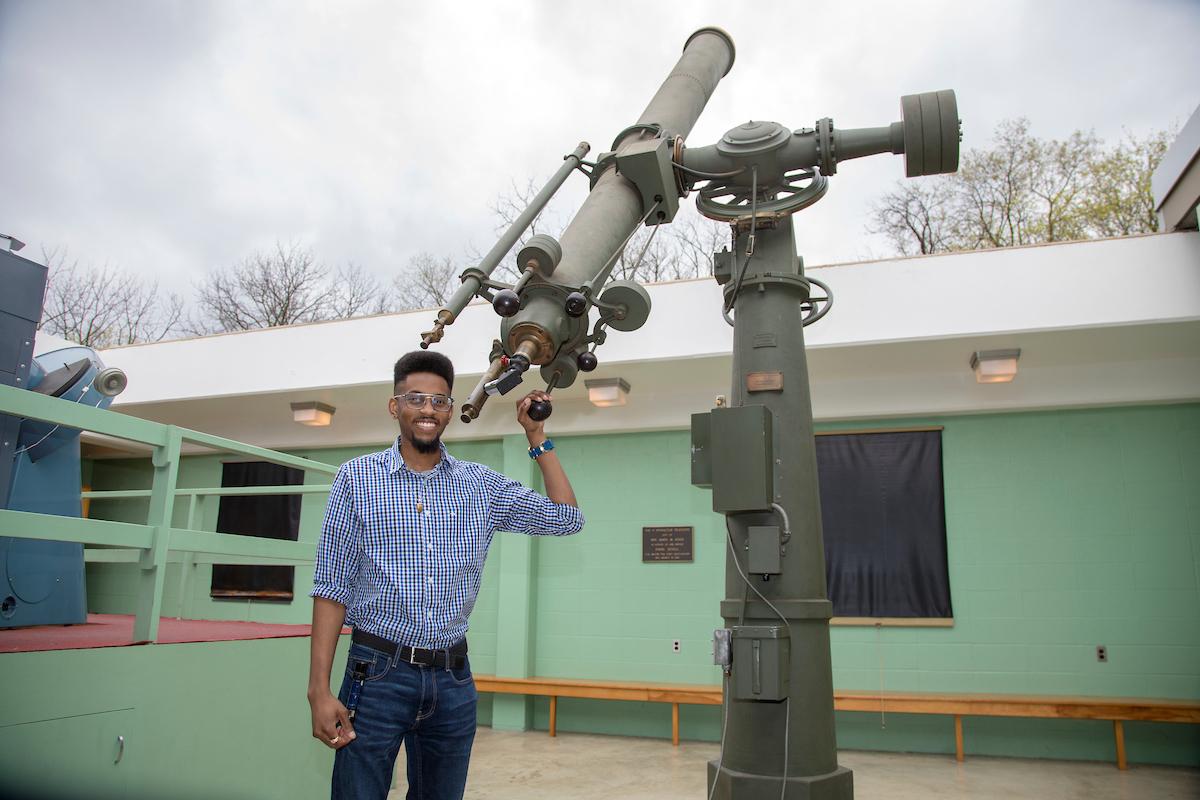
Joseph R. Grundy Observatory
The Joseph R. Grundy Observatory provides exciting opportunities to explore the universe right on the F&M campus. The
Grundy Observatory features an 1884 vintage 11-inch Alvan Clark refracting telescope
and a 16-inch Boller & Chivens classical Cassegrain reflecting telescope.
Learn more
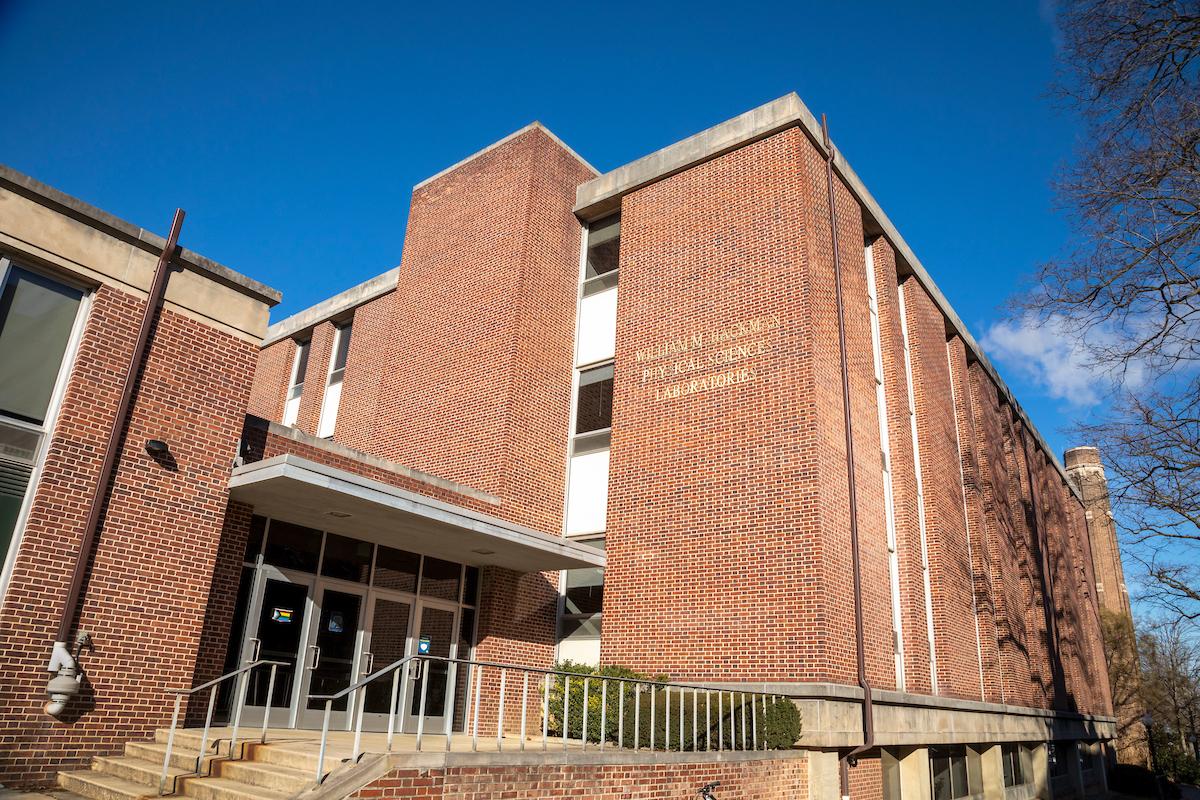
The William M. Hackman Physical Sciences Laboratories
The hub of astrophysics at F&M is the William M. Hackman Physical Sciences Laboratories building. Hackman houses six instructional laboratories; 12 student/faculty research laboratories; a telescope deck and imaging lab; an ellipsometer; a small radio telescope; the Beowulf Cluster, a group of equipment primarily used for pulsar survey data processing; and a lounge for physics majors to gather to study and share thoughts and ideas.
Astronomy Research Lab
Located in the William M. Hackman Physical Sciences Laboratories building, the astronomy research lab is a space designed for our research students to work on astronomy research projects. Students typically work on these projects during summers but also sometimes during the year. The lab has a number of Linux computers that we use for research, a printer, plenty of disk space, and several IDL licenses. This room is also used for the NANOStars program at F&M. You can explore some of the other research projects that students have worked on in the lab.
Small Radio Telescope
The Small Radio Telescope (SRT) is a 2.3 m diameter satellite television dish on a fully motorized Az-El mount which has been developed by Haystack Observatory. The SRT at F&M is located on the roof of Hackman Physical Sciences Laboratory and is capable of both total power measurements and contour mapping. This telescope observes at L-band (a wavelength of 20 cm, or a frequency of 1.4 GHz) and is used in part of our lab instruction in both our introductory astrophysics course and senior-level laboratory capstone course for majors. The SRT control computer is located in the astronomy lab on the fourth floor of Hackman. The telescope is capable of both radio continuum and spectral line observations and combines aspects of astronomy, digital signal processing, software development, and data analysis and reduction.
Telescope Deck and Imaging Lab
The observing deck in the William M. Hackman Physical Sciences Laboratories contains low vibration piers which hold six 8-inch Meade LX-200 telescopes. Cables in conduit under the floor connect the telescopes with six laboratory PCs. The telescopes can be operated in three modes: students can begin learning about telescopes by moving and pointing the telescopes manually; the telescopes can also be controlled using the computer built into the telescope base with commands entered through the hand paddle; finally, the telescopes can be controlled from the computers inside the lab. The astronomical imaging laboratory, located next to the observing deck, allows students taking astronomy courses to work with computer controlled telescopes and CCD cameras to record and process images of celestial objects.
Each telescope is equipped with an SBIG ST-7 CCD camera with a 5-position filter wheel. Sub-floor cables connect the CCD cameras to the lab computers, where students can operate the cameras and telescopes, record images, and enhance and measure images. Software on the lab computers includes The Sky, a planetarium program that allows students to point the telescopes and CCDSoft, a program that controls the camera and permits analysis and measurements from images. Students can switch from program to program with a single click of the mouse to move the telescope and record images.
In addition to controlling the telescopes and cameras, the imaging laboratory is also designed to support cloudy night labs and student projects. Although six computers are connected to the telescopes, the lab also contains additional computers. All of these computers contain CLEA software for cloudy night labs and are used by classes and by individual students for projects. All of the computers are networked to the Internet for ease in communication with astronomical databases world wide.
The imaging laboratory at F&M was used by classes beginning with the 1997-98 school year. A new spectrograph has been purchased and is currently being installed and tested. It will permit students in upper level courses to obtain spectra of planets and bright stars and to analyze the spectra. We are continuing to develop new ways for astronomy students to use the laboratory and experience digital imaging in astronomy.
National Undergraduate Research Observatory (NURO)
F&M is a member of the National Undergraduate Research Observatory (NURO) located in Flagstaff, Arizona. Teams of faculty and students regularly make trips to the observatory for training and research experiences.
The North Museum Planetarium
The nearby North Museum houses the largest planetarium in Central Pennsylvania. The planetarium is regularly
used in F&M astronomy classes, and there are a variety of shows given to the public
throughout the year. The museum also has a number of other astronomy exhibits for
all ages. Admission to the museum and planetarium is free with your F&M ID.
Success Beyond F&M
Graduate School
Many of our graduates go on to pursue advanced degrees after F&M. They’re admitted into some of the nation’s finest graduate programs, including:- California Institute of Technology
- Columbia University
- Cornell University
- Massachusetts Institute of Technology
- Princeton University
Career Paths
Career outcomes for astrophysics graduates are diverse. Some have gone on to work as scientists at NASA, while others have held positions such as:- Aerospace Engineer
- Astronomer
- Astrophysicist
- Computational Scientist
- Data Scientist
- Energy Industry Analyst
- Engineer
- Materials Scientist
- Meteorologist
- Process Engineer
- Research Scientist
- Quantitative Research Analyst
- Seismologist
Alumni Spotlight
A Childhood Promise Leads to a Princeton PhD
At F&M, Raptis spent a great deal of his time engaged in research, much of it alongside
one of his mentors, Associate Professor of Physics Ryan Trainor. He is now pursuing
a PhD at Princeton University, where he says he will be diving deeper into research
and working “at the intersection of observational, computational astronomy and theoretical
astrophysics, to study and understand the early universe.”
Read More »Research Spotlight
Mapping the Cosmos with F&M’s Supercomputer
“Radio pulsars are compact rotating stars that emit radio waves as pulses that can
be detected with large radio telescopes,” said Crawford, the Charles A. Dana Professor
of Physics and Astronomy. “These signals are generally very faint, and sophisticated
analysis packages must be applied to detect them.”
Crawford enlists students on his quest to map the cosmos, offering his undergraduate
mentees a distinctive opportunity to experience innovative technology firsthand while
researching alongside a faculty expert.
Read More »Eclipse Trivia
Take Your Next Step
Grundy Observatory is open to public observing on the third Monday of each month all
year (weather permitting).Public Observing Night at the Observatory
May 11, 2026 This year, the Williamson Medal — the highest student award for character, leadership and scholarship presented each year at Franklin & Marshall’s Commencement for more than a century — was awarded to Menelaos Raptis. March 13, 2026 How do you find a needle in a galactic haystack? Fronefield Crawford is harnessing the computational strength of F&M’s High-Performance Computing (HPC) cluster to pinpoint the location of rotating stars in our neighboring galaxies. October 1, 2025 A Diplomat's influence reaches everywhere — even the skies of Japan. This summer, a handful of astrophysics majors and their professor enjoyed a two-week trip to Japan that was “part pulsar science expedition, part cultural exchange related to the NANOStars program at F&M," says Fronefield Crawford, Charles A. Dana Professor of Physics and Astronomy. Astrophysics in the Spotlight
The 2026 Williamson Medal Winner: Menelaos Raptis
Mapping the Cosmos with F&M’s Supercomputer
Starstruck in the Land of the Rising Sun
As technology evolves and our understanding of computerized systems increases, computer
science has become more advanced. At F&M, you’ll explore this ever-changing field,
learning the mathematical basis of modern computer science, gaining technical and
programming skills, and understanding how to put theory into practice. The study of mathematics is ancient, and its roots in clear and creative thought can
still be seen today. While studying mathematics at F&M, you will learn both the fundamental
foundations and theories of the field as well as how to apply these theories to real-life
problems. From questions about the origins of the universe to integral inquiries about magnetism
and electricity, the study of physics reshapes the way we perceive the natural world.
Physics at F&M provides ways for you to examine complicated natural systems, explain
your observations, and develop models that predict future behaviors.Related Fields of Study
Computer Science
Mathematics
Physics