
F&M Stories
Powering Innovation: Inside F&M’s Campus Supercomputer
Imagine 1,600 computer processors combining power toward one task. This supercomputer accelerates discovery, uncovering results within days - not months. Researchers are empowered to scale up their studies and ask larger, more complicated questions. It inspires collaboration between faculty and curious students eager to gain hands-on experience in cutting-edge research. This innovative technology — called a High-Performance Computing (HPC) cluster — is real. And it can be found right here at Franklin & Marshall College.
F&M has received three National Science Foundation (NSF) Campus Cyberinfrastructure (CC*) grant awards — totaling $1.2 million — dedicated to enhancing this shared research infrastructure. F&M is the first among small liberal arts colleges to receive three CC* awards from the NSF.
“It's very rare for even the most highly selective liberal arts schools to have a shared campus cluster. It's more common to have a small cluster dedicated to an individual researcher, or small research group,” said Jason Brooks, director of research computing services. “We were awarded the HPC cluster because of the vast scope of our student and faculty research. It’s a shared resource, accessible to anyone in our campus community doing computational research.”
F&M’s Research Computing Services acts as an essential partner in propelling scholarly discovery by offering a vital combination of specialized training, strategic support for grant applications, and sophisticated computational power and data management — including F&M’s HPC cluster. An HPC cluster is a group of powerful computers linked together by an ultra-fast network to work as one single machine. It’s designed to handle massive calculations and data-heavy research that a standard desktop can't manage. F&M’s cluster features:
- Massive processing power of 40 high-speed server units, the equivalent of 1,600 computer processors running simultaneously. Soon, the processing power will be expanded to 42 units.
- Specialized Graphics Processing Units (GPUs) dedicated to AI and advanced research, allowing for much faster processing of complex visual or data-driven patterns.
- A massive storage system currently holding 300 terabytes (TB) of data, set to grow to two petabytes. That’s enough storage for two billion photos, 163 years worth of video, or 750 million e-books.

F&M's High-Performance Computing (HPC) Cluster. Photos by Deb Grove.
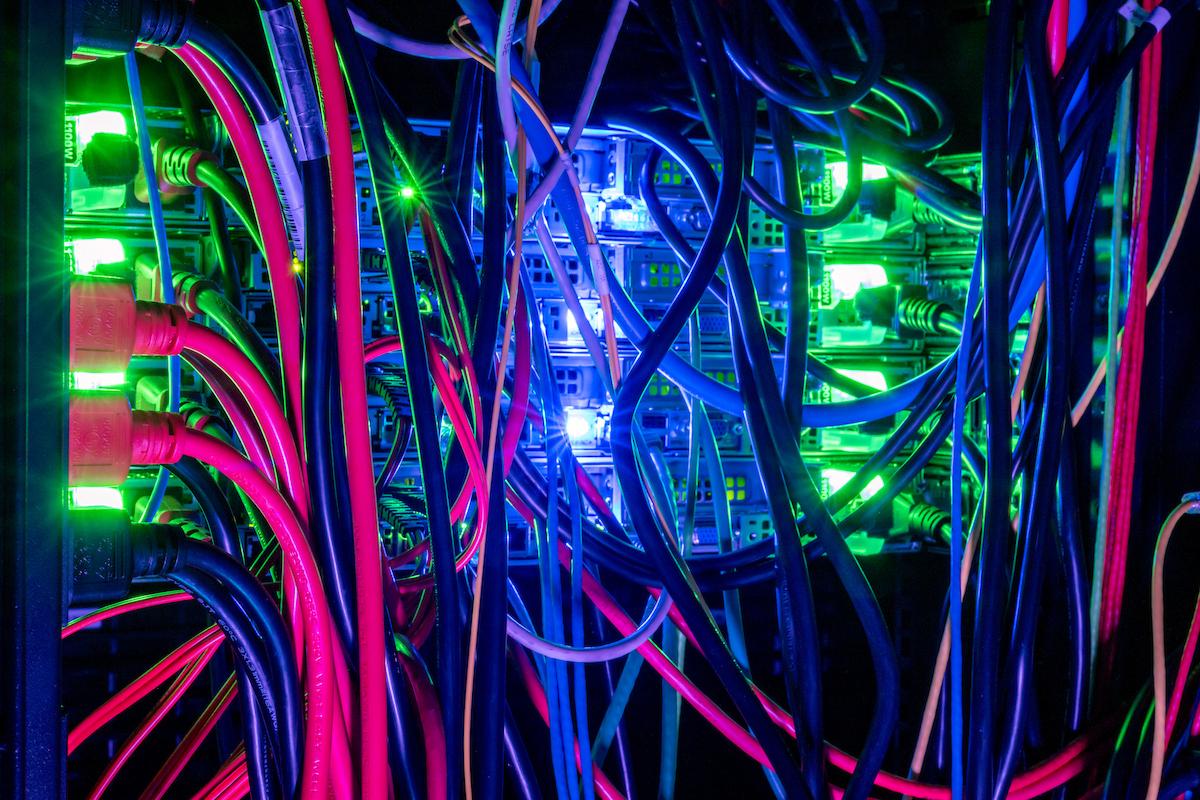
F&M's High-Performance Computing (HPC) Cluster. Photos by Deb Grove.
“Data-intensive science is growing. As a researcher, having access to high-capacity data-transfer resources, data storage, and compute power is essential for an effective research agenda,” said Carrie Rampp, vice president and chief information officer at F&M. “Our researchers are doing increasingly more sophisticated data collection, in the field and in their labs. Our HPC cluster optimally positions our faculty and students to undertake data-intensive research.”
Research is part of our DNA as Diplomats. F&M is the nation’s No. 11 Best Liberal Arts Colleges for Research (Wall Street Journal-College Pulse), and the 2025 Carnegie Classification of Institutions of Higher Education ranked F&M among leading national institutions that prioritize research activity. This distinction recognizes research activity at institutions that primarily focus on undergraduate education and spend at least $2.5 million annually on research. With a 9:1 student-to-faculty ratio and 51% faculty-student collaboration rate, F&M provides unparalleled access to leading faculty experts, creating a dynamic environment marked by creative collisions in every corner of campus.
The HPC cluster serves as a cross-disciplinary engine, driving research in areas of study such as computer science, mathematics, astrophysics, biology, chemistry, and physics.
“Without F&M's computational resources we would be unable to store, manage, and most importantly process these data,” said Dan Ardia, Associate Dean of the Faculty and Charles A. Dana Professor of Biology. “It is rare to have such high-end processing and storage capacity at a school like ours.”
By removing the traditional limits of data processing, the cluster allows F&M researchers to explore complex questions:
- Ardia utilizes the cluster’s AI capabilities and high-end processing power for applied conservation research. He and his students collaborate with our research computing team to analyze field recordings and images to understand how human impacts and environmental change affect bird and mammal populations.
- Peter Fields, The Dr. E. Paul & Frances H. Reiff Professor of Biology, utilizes the cluster’s specialized graphics processors to run millions of simultaneous calculations, creating “molecular movies” that track how atoms in a coral protein react to high temperatures.
- Fronefield Crawford, Charles A. Dana Professor of Physics and Astronomy, harnesses the cluster to process large, complex astronomical data sets in the search for radio pulsars in neighboring galaxies, reducing typical data processing times of months to less than a week.
“By bringing all our resources together into one central system, we’ve made it possible for faculty and students to get their work done faster — which leads to more research,” Brooks said. “Our HPC cluster empowers researchers to scale up their work, look at solving larger problems, and engage in more student-faculty collaboration that is a staple of research at F&M.”
Related Articles
September 2, 2026
‘I Find It Important and Necessary’: Uncovering Lancaster's Hidden History
For Frances Taylor ’27, the Lancaster Vice project checked all the right boxes: collaborating with a faculty mentor, exploring how their two majors converge in the real world, and unearthing stories the city had forgotten. “I enjoy learning about hidden history that popular culture often overlooks,” Taylor said.
July 20, 2026
F&M Experts Weigh in on Wildfire Air Quality
As Canadian wildfire haze blanketed the mid-Atlantic last week, local news sources turned to experts at F&M for air quality and public health insights. Professor of Geosciences Robert Walter '75 has been monitoring Lancaster’s air-quality index via a sampler machine atop of the Alumni Sports & Fitness Center.
July 16, 2026
Decoding the Genome: F&M Public Health Alum Investigates Hantavirus
Anna Catherine Grady ’19 arrived at F&M with veterinary school aspirations. A few public health courses later, she discovered a love of research and a holistic approach to the discipline that reoriented her career path.