
F&M Stories
AI Research Bridges Environment and Economic Studies
How do you prove the economic value of clean water?
Nancy Nguyen ’26 and Vu Nguyen ’26 tackled that question with a unique combination of field research and artificial intelligence. Their area of focus is the Chesapeake Bay Watershed, North America's largest estuary.
Under the guidance of Patrick Fleming, associate professor of economics and public policy, the students used AI as a preliminary expert to gauge the influence of six different water-quality indicators on children's health, fish health and flood risk (defined as ecological goods and services).
“I was fascinated by the idea of using economic tools to evaluate aspects of the environment that are not easily measured in dollars, helping people understand its value and how to improve it,” Nancy said.
Water-quality indicators included: nitrogen, phosphorus, turbidity, E. coli, water temperature and discharge (water flow).
Professors Bob Walter and Patrick Fleming at the site of a dam collapse in Lancaster
County.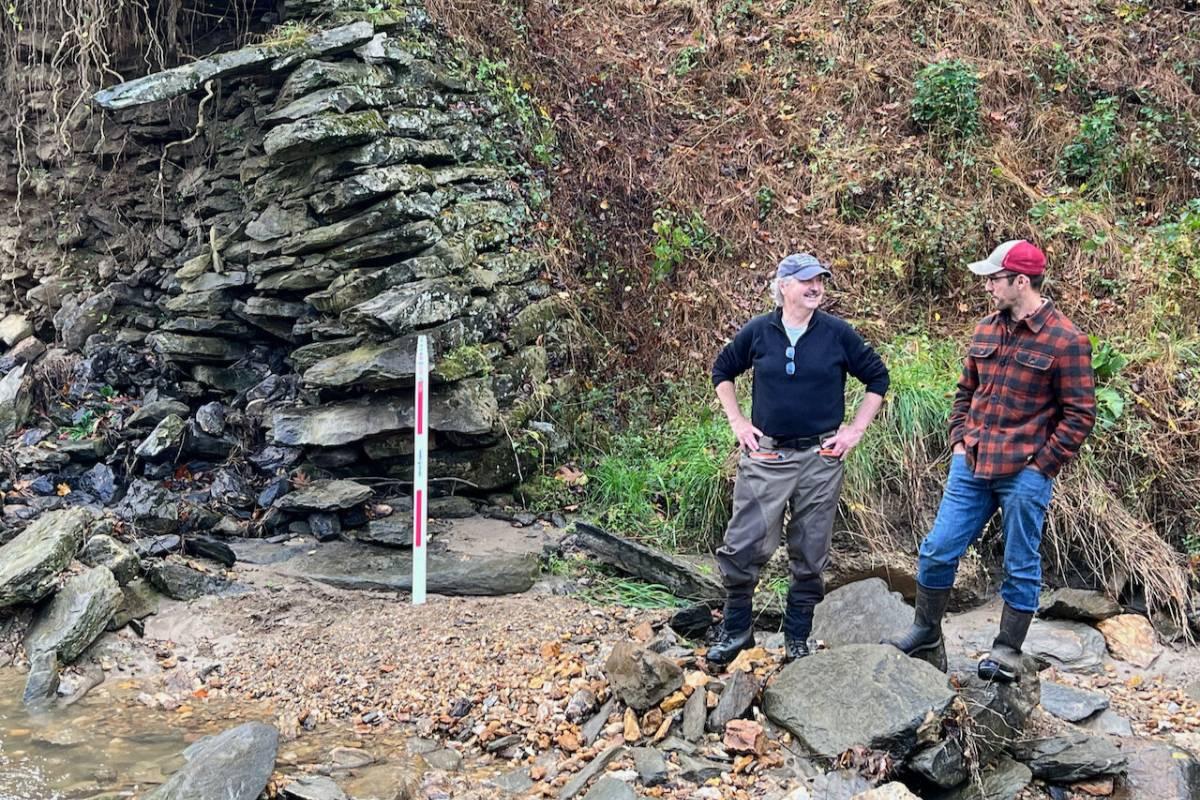
Students provided AI with random numbers for water-quality indicators (to account for fluctuating conditions) and trained AI to gauge water safety, creating a helpful prediction tool.
When budget and time are limited, AI serves as a useful aid to sift through large datasets without replacing original research.
“Students can use it to enhance or build upon research, as opposed to substituting,” Fleming said.
“You have to approach AI in a conscientious way,” Vu said. “You want AI to do some of the redundant work, and maybe ask about its thought process, but you never let AI take away your intellectual autonomy.”
Below, meet the student researchers.
"You want AI to do some of the redundant work, but you never let AI take away your
intellectual autonomy."
Vu Nguyen ’26
- Hometown: Hanoi, Vietnam
- Major: Economics
- Minor: Applied mathematics
What inspired you to explore this topic?
This research was a perfect opportunity for me to delve into a topic that I have never explored before: environmental economics. The more I read into this discipline, the more I was intrigued by how economists can determine prices of environmental elements that do not belong in markets. But more importantly, this discipline provides urgency to environmental matters that have long plagued our society as a whole.
What is the greatest opportunity or challenge for the future use of AI in this field?
A lot of data analysis and redundant work can be simplified with the use of AI. AI is only getting better at handling large databases, and we should utilize that for environmental economics research.
However, there is also a great cost in how we can implement AI to brainstorm our ideas. AI cannot really provide original ideas for academic research, but we tend to treat AI as an expert that can think for us. For now, at least in the field of economics, we should approach AI with caution.
"I was fascinated by the idea of using economic tools to evaluate aspects of the environment
that are not easily measured in dollars."
Nancy Nguyen ’26
- Hometown: Ba Ria Vung Tau, Vietnam
- Double major: Data science, economics
- Minor: Applied mathematics
How has this project helped you along your chosen career path?
This project helped me gain experience working on AI-related projects and explore how AI can support real-world applications. I previously collaborated with Professor Christina Weaver to build a model using AI to help a nonprofit organization provide nutritious food to students in Lancaster County.
I have also taken computer science courses to better understand AI, and attended a data science conference where scientists from around the world discussed how AI can improve systems and make work more efficient. These experiences have inspired me to pursue a career in data analytics, where I aim to collaborate with AI as a tool to produce meaningful results that benefit society.
What advice would you give to students using AI to assist with research?
Always keep a human in the loop. Humans need to remain at the center of the work, using AI as a tool rather than relying on it to do everything. This approach allows us to gain deeper insights from the work, rather than just producing basic results.
Your ideas may start in the classroom, but they won’t be contained there. Learning
by doing is part of our DNA as Diplomats. At F&M, you can connect the things you care
about to meaningful experiences, including research, internships, volunteering, and
more. Real-World Learning
Related Articles
September 24, 2026
F&M Poll: Economic Concerns Shape Voter Attitudes in Pa. 7th and 10th Districts
The preferences of registered voters living in Pennsylvania’s 7th and 10th Congressional Districts show patterns that are similar to state and national data that favor Democratic candidates, according to the latest Franklin & Marshall College Poll.
September 8, 2026
Lancaster Internship Shapes Pre-Law Path
Molly DeBrandt ’28 transformed academic curiosity into career conviction. As an intern with the Office of the Public Defender of Lancaster County, she stepped directly into the daily realities of public defense and discovered a passion for law. “I now intend to apply to law school following my graduation from F&M,” she said.
September 2, 2026
‘I Find It Important and Necessary’: Uncovering Lancaster's Hidden History
For Frances Taylor ’27, the Lancaster Vice project checked all the right boxes: collaborating with a faculty mentor, exploring how their two majors converge in the real world, and unearthing stories the city had forgotten. “I enjoy learning about hidden history that popular culture often overlooks,” Taylor said.