
F&M Stories
Willie Wilson Awarded NSF CAREER Grant for Computer Science
Ongoing research into robots and machine ethics has resulted in a prestigious National Science Foundation CAREER grant for Jason “Willie” Wilson, assistant professor of computer science at Franklin & Marshall College.
The $505,358, five-year grant – now active – supports early-career faculty who have the potential to serve as academic role models in research and education and to lead advances in the mission of their department or organization. The Faculty Early Career Development (CAREER) program offers the NSF’s most prestigious awards in support of early-career faculty.
“I’m particularly proud that both the research and education plan for this work emphasizes the ethical application of technology,” Wilson said.
The funded research, “Transparent Theory of Mind Algorithms for Social Robots Assisting Young Children,” will examine how social robots use human-like, cognitive abilities to better understand and thus better aid young children. The robots are housed in Wilson’s lab at F&M.
The grant will fund numerous paid student research positions over the next five years.
Additionally, Wilson will look to hire a graduate research assistant each summer to bring graduate-level research to F&M.
“I’m particularly proud that both the research and education plan for this work emphasizes
the ethical application of technology.”
Wilson’s CAREER grant supports the continuation of two projects.
The first, examining child-robot interaction and learning, is a collaboration with F&M Associate Professor of Psychology Lauren Howard and researchers at Temple University.
Researchers – including F&M students – compared child responses to human and robot instructors.
While the first project focuses on psychology and human perceptions, the second line of research is computational and focuses on theory of mind. (In the context of artificial intelligence, “theory of mind” means equipping machines with the ability to comprehend, predict and respond to the mental states of humans and other AI agents.)
“We want the robot to have theory of mind so it can understand what the child is doing, understand what the child's goals are, understand what the child's beliefs and misunderstandings are,” Wilson said.
Wilson emphasizes that previous and upcoming research with robots has much broader implications.
“How do we inform students about the ethical and social implications of technology? That is a topic I've been thinking about a long time. I always put some piece of this into all of my classes,” he said.
In spring 2025, Wilson will introduce a new course: Learning and Teaching Machine Ethics. The course will help expand machine ethics curricula to disciplines outside computer science “so that machine ethics is getting disseminated more broadly,” Wilson said.
Students will play an important role in developing curricular materials for courses in sociology, public health, economics and other fields of study.
The ethical application of technology is a driving force behind all of Wilson’s work.
“I don't want technology taking advantage of vulnerable populations. I want technology to be able to enhance their own abilities,” he said.
“There's a tone of ethics through everything I'm doing, both on the education side and on the research side,” he added. “As we look at rapidly growing AI, now is when we need that perspective the most.”
Wilson completed a joint doctorate in computer science and cognitive science at Tufts University, and was a postdoctoral associate in the department of computer science at Northwestern University. He has taught computer science at F&M since 2020. Follow his research updates at F&M CARES Lab.
Ongoing research into robots and machine ethics has resulted in a prestigious National
Science Foundation CAREER grant for Jason “Willie” Wilson, assistant professor of
computer science at F&M. (Photo by Deb Grove) 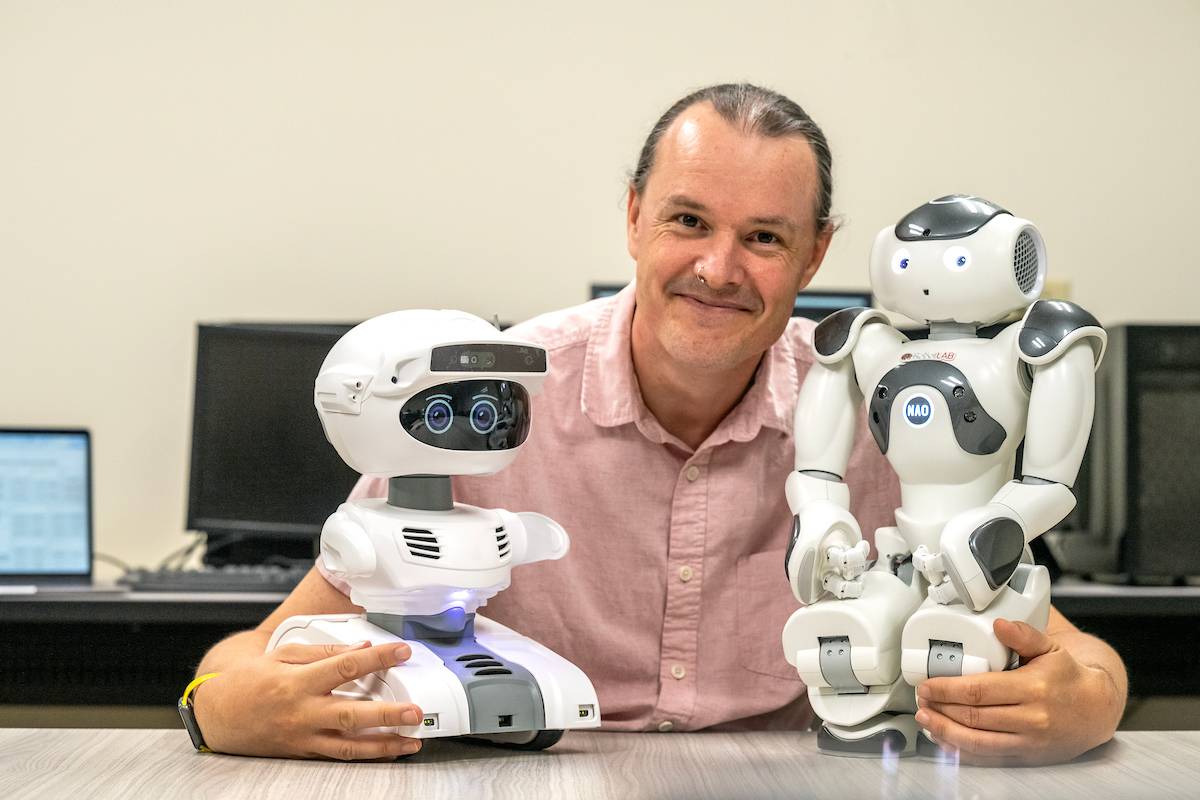
F&M's computer science research symposium introduces students to the opportunities
available in artificial intelligence, robotics, app programming and other projects.Students: Computer Science Research Wants You
F&M Hackman Scholars spent a summer testing robot-child interaction and learning under
the tutelage of Associate Professor of Psychology Lauren Howard and Assistant Professor
of Computer Science Willie Wilson.Child-Robot Research Merges Psychology and Technology
Related Articles
September 2, 2026
‘I Find It Important and Necessary’: Uncovering Lancaster's Hidden History
For Frances Taylor ’27, the Lancaster Vice project checked all the right boxes: collaborating with a faculty mentor, exploring how their two majors converge in the real world, and unearthing stories the city had forgotten. “I enjoy learning about hidden history that popular culture often overlooks,” Taylor said.
August 24, 2026
F&M and Fulton Bank: Where Liberal Arts and Innovation Meet
For Moemen Ibrahim ’26, an assignment to reach out to a Franklin & Marshall College alumna on LinkedIn led to much more than a career conversation. It became the beginning of an internship and an introduction to the world of innovation at Fulton Bank — and has also led to a full-time job.
August 18, 2026
Biology Professor Brews Up New Beer Science Course
F&M Professor of Biology Rob Jinks concocted the first course of its kind this summer: Brewing Science. The one-month intensive course and corresponding labs introduced students to the science and art of crafting beer from four fundamental ingredients: water, malted grain, hops, and yeast.