
Computer Science and AI
Artificial Intelligence (AI) has been taught and researched at F&M for over a decade. Just as technology never stands still, our curriculum adapts alongside the rapid pace of innovation. The Department of Computer Science at F&M brings a distinct liberal arts focus to what is considered to be a technical field of study. In addition to learning the mathematical and programming foundations of AI systems, our courses are developed to teach you how to critically design, evaluate, and communicate ideas with others. We have also spearheaded cutting-edge research into AI’s role in the classroom, led an initiative to develop an AI ethics curriculum for courses across the College, and established a new Artificial Intelligence and the Liberal Arts certificate.
AI-Related Courses
Ready to examine AI through a liberal arts lens? These recent course offerings highlight a broad perspective on how AI works and its impacts on society.
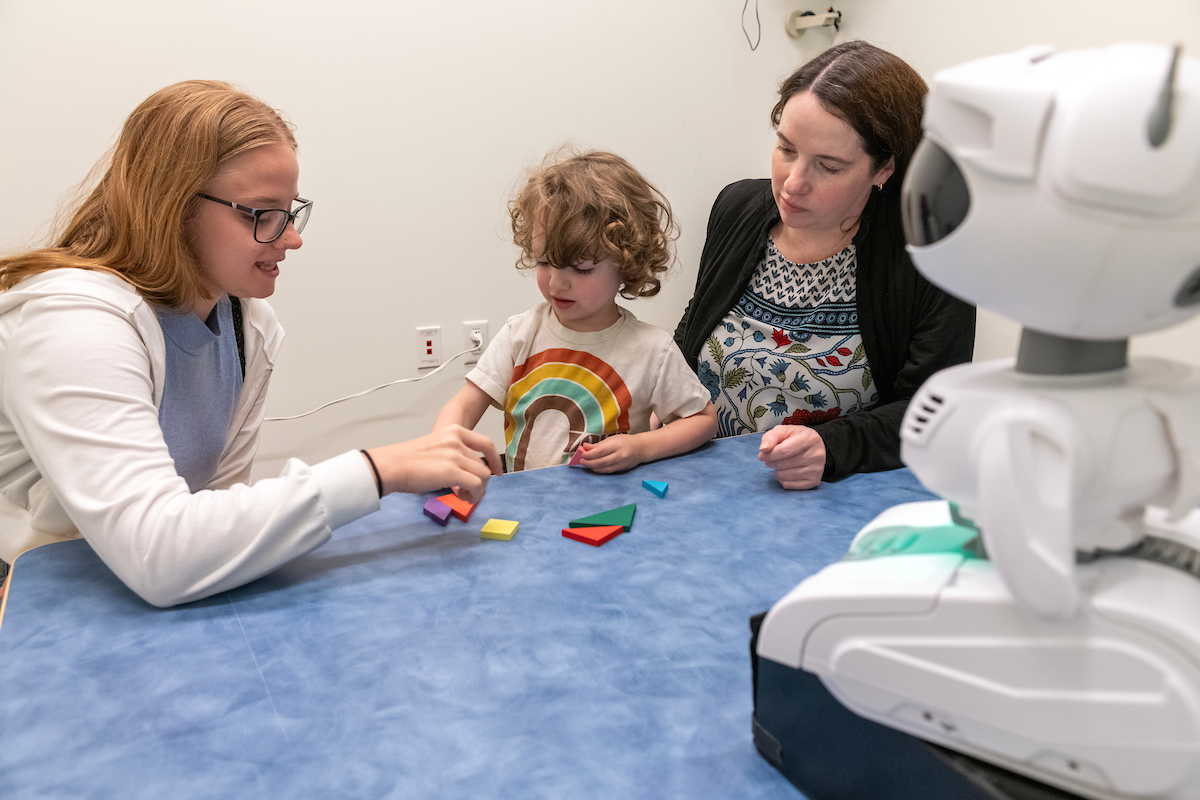
CPS/PSY 278 - Children & Technology
This is an interdisciplinary course that explores how to build and evaluate technologies (from simple toys, to screens, to complex robots) for children. You will learn how AI technologies such as emotion detection, intelligent tutors, chatbots, and robots have become a normal part of a child’s life. You will develop your own research projects to investigate how AI can be used to help children grow and develop as well as how children directly interact with modern AI systems.
CPS 360 - Intro to Machine Learning
In this class, you will learn about recent techniques that allow computers to learn using data and feedback. You will experience the entire machine learning pipeline, starting with creating your own dataset and ending with communicating your results to stakeholders. This class will give you the mathematical background to understand AI models and a practical introduction to common machine learning libraries in Python, a popular programming language.
CPS 363 - Intro to Bioinformatics
In this class, you will apply machine learning techniques to solve important problems in molecular biology. This class illustrates how AI tools can be used across disciplines to help solve problems that are too big for humans to attempt alone.
CPS 367 - Artificial Intelligence
In this class, you will learn the surprising interdisciplinary history of AI before the current popularity of machine learning. You will develop your own AI agents using logical rules, probabilistic uncertainty, and search. Through the course projects you will create a chatbot with personality and an agent that will find the optimal path between your classes on campus.
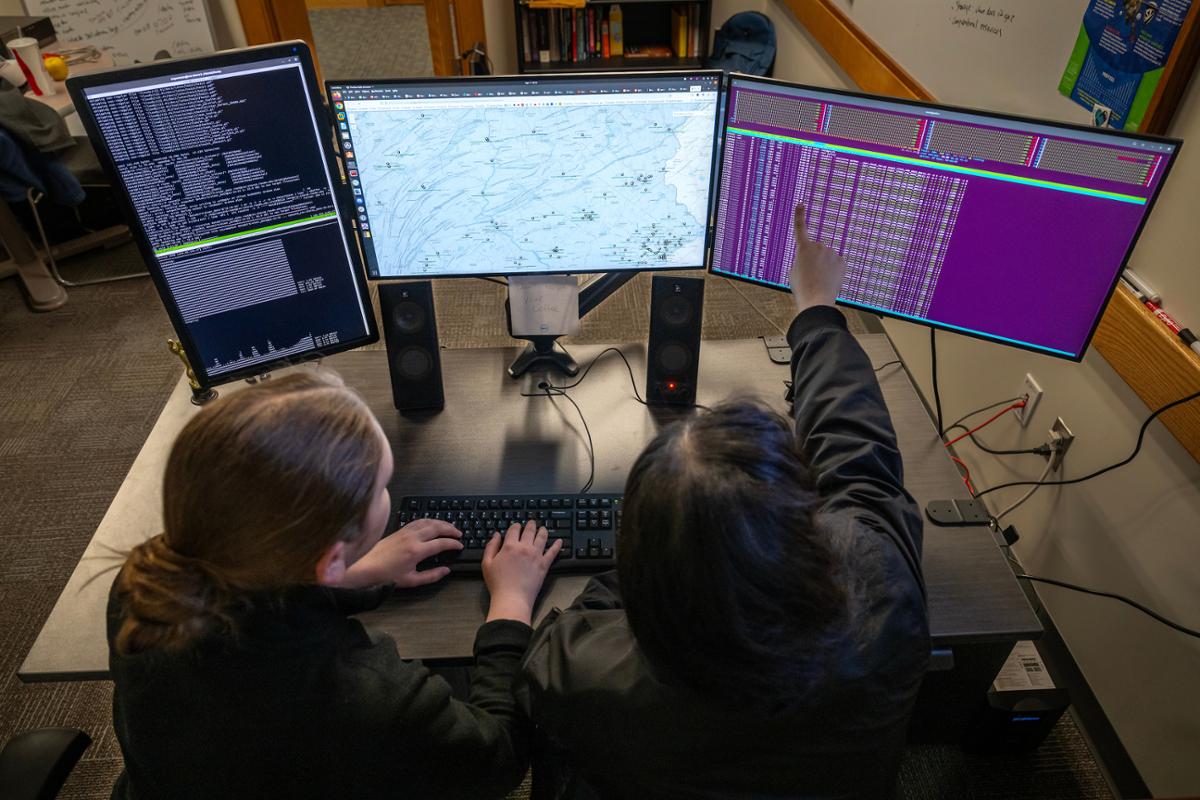
CPS 371 - Human-Robot Interaction
This course intentionally brings together students from various disciplines on campus to learn about how humans and robots can interact and work together. You will learn how AI technologies such as facial detection, speech processing, and automated planning allow robots to interact with humans. You will work with a group to design your own robot behaviors using these tools while also considering various ethical frameworks.
CPS 372 - Entropy/Information Theory
In this class, you will learn the mathematical foundation of randomness and how it impacts the data we send and receive every day. You will learn the limitations of how we can encode information, how to anticipate and correct errors, and why we can never train a “perfect” AI model. You will directly apply this knowledge to training neural networks and develop your own project in an area of your choice.
CPS 374 - Usable Privacy and Security
This course explores privacy and security systems from a human perspective. You will learn how your information can be found and used by others to train their own AI systems. Using principles from the Human-Computer Interaction (HCI) community, you will create tools such as password managers and message encryptors that are designed to be easy to use in addition to protecting your data.
CPS 460 - Deep Learning and Generative AI
In this class, you will dive deeper into the world of machine learning, focusing on neural networks and their generative AI applications. You will learn how to build AI models that can process text and images while also using specialized hardware such as graphic processing units (GPUs). This class will teach you the mathematical background of these AI models and how to make them run more efficiently.
Curate Your Curriculum
If you are interested in data and theoretical foundations, consider taking:
- CPS 360 - Intro to Machine Learning
- CPS 367 - Artificial Intelligence
- CPS 372 - Entropy/Information Theory
- CPS 460 - Deep Learning and Generative AI
- CPS 273 - Teaching and Learning Machine Ethics
- CPS/PSY 278 - Children & Technology
- CPS 363 - Intro to Bioinformatics
- CPS 371 - Human-Robot Interaction
- CPS 374 - Usable Privacy and Security
An AI Certificate to Prepare World-Ready Leaders
Certificates are supplemental educational pathways you can pursue that are not tied to your major or minor. The Artificial Intelligence and the Liberal Arts certificate introduces a distinct approach to examine AI through a blended lens of humanistic inquiry and technical proficiency. With coursework that spans the sciences and humanities, the curriculum simultaneously explores the technology, its history, and its societal implications. This foundation culminates in real-world, hands-on experiences, such as internships or research projects.
Explore F&M certificates »AI in the Classroom
AI tools like ChatGPT have rapidly changed how we learn. At F&M, the Department of Computer Science is embracing this change to provide an exceptional education. We're committed to ensuring students are prepared for a future where AI is commonplace, and we’re adapting our teaching methods to make the most of these new opportunities.
Instead of banning or policing the use of AI tools, we have open conversations with students about them – encouraging a holistic view of the practical and ethical considerations of AI. In addition, our professors are exploring alternative forms of assessing what you have learned. Many courses now use assessments like oral exams or code explanation/justification, assigning grades based on demonstrating a deep understanding of the material. Through this approach, we seek to reward students for working to master the concepts rather than focus on points earned on assignments or memorizing for a test. This approach also serves to develop important communication skills that employers value.
In some advanced courses like Bioinformatics, Usable Privacy and Security, or Mobile Applications, professors encourage the use of AI tools to help students focus on core learning objectives. For example, instead of spending time on tedious tasks like cleaning data or learning the syntax of a new programming language, students can concentrate on advanced skills like data analysis, user evaluations, or application design. This allows students to gain a deeper dive into the topic and gain practical, real-world experience.
At F&M, we’re committed to equipping students with the skills they need to thrive in the rapidly evolving world of computing, however they interact with it.
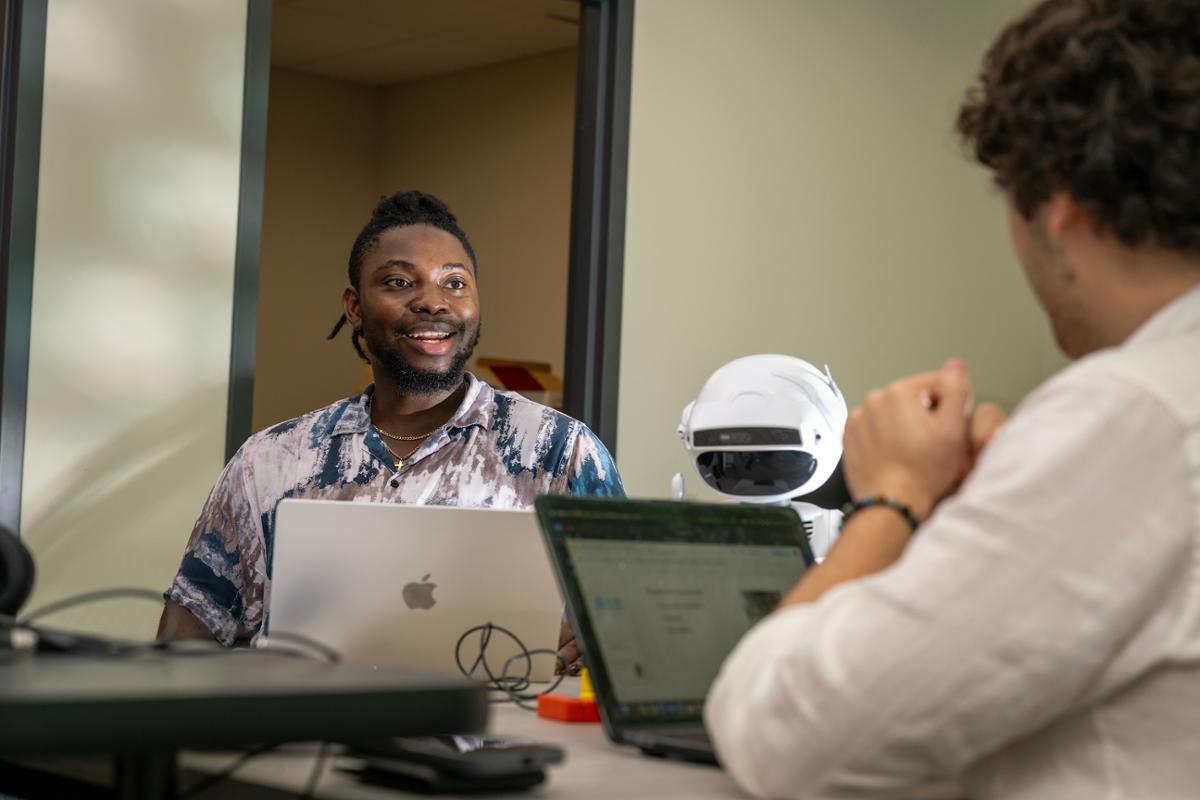
Students Developing AI Ethics Curricula
Assistant Professor of Computer Science Jason "Willie" Wilson and El Muchuwa '26 co-designed a multidisciplinary course that challenges students to navigate the complex intersection of AI and ethics. Bringing together majors from computer science, data science, cognitive science, and psychology, the curriculum explores critical issues like algorithmic bias, data privacy, and transparency. As part of the course, student teams collaborated with faculty across various fields—from public health to creative writing—to develop original AI ethics materials. This innovative approach to AI education was recently published and presented at the SIGCSE Technical Symposium, highlighting F&M’s leadership in preparing the next generation of responsible AI developers.
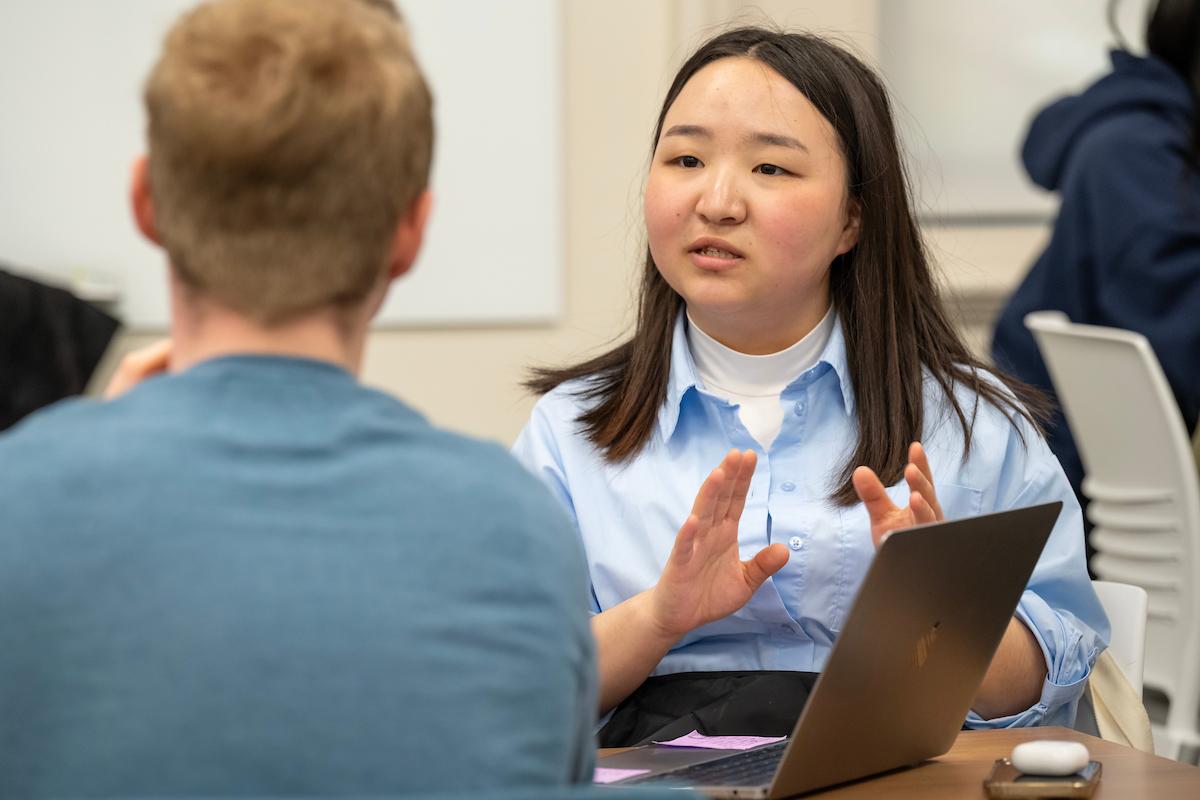
Individualized AI-Generated Quizzes
Associate Professor of Computer Science Ed Novak and Assistant Professor of Computer Science Brad McDanel are adapting assessments to account for the significant impacts large language models (LLMs) are having on teaching introductory computer science courses. Many computer science departments across the country have attempted to ban these tools in their introductory courses. At F&M, the approach taken by Novak and McDanel focuses on making sure students understand what they’ve submitted. They use an LLM to create personalized, in-class quizzes based on each student's specific homework code. This motivates them to understand the code they submit, since they'll have to explain it on the quiz. The professors stay involved by checking the quizzes before they're distributed, and hand-grading the results to keep things fair and human.
AI and Research
Research is part of our DNA as Diplomats. In fact, F&M is the nation’s No. 11 Best Liberal Arts College for Research (Wall Street Journal-College Pulse), and the 2025 Carnegie Classification of Institutions of Higher Education ranked F&M among leading national institutions that prioritize research activity.
Computer science faculty are engaged, accomplished scholars who conduct groundbreaking work in their fields of expertise. Their studies — including projects funded by the National Science Foundation — spans the evolution of the field, from pioneering symbolic logic to novel deep-learning algorithms. With a 9:1 student-to-faculty ratio and 51% faculty-student collaboration rate, you have remarkable opportunities to join their research projects and make your mark on what sometimes are years-long endeavors.
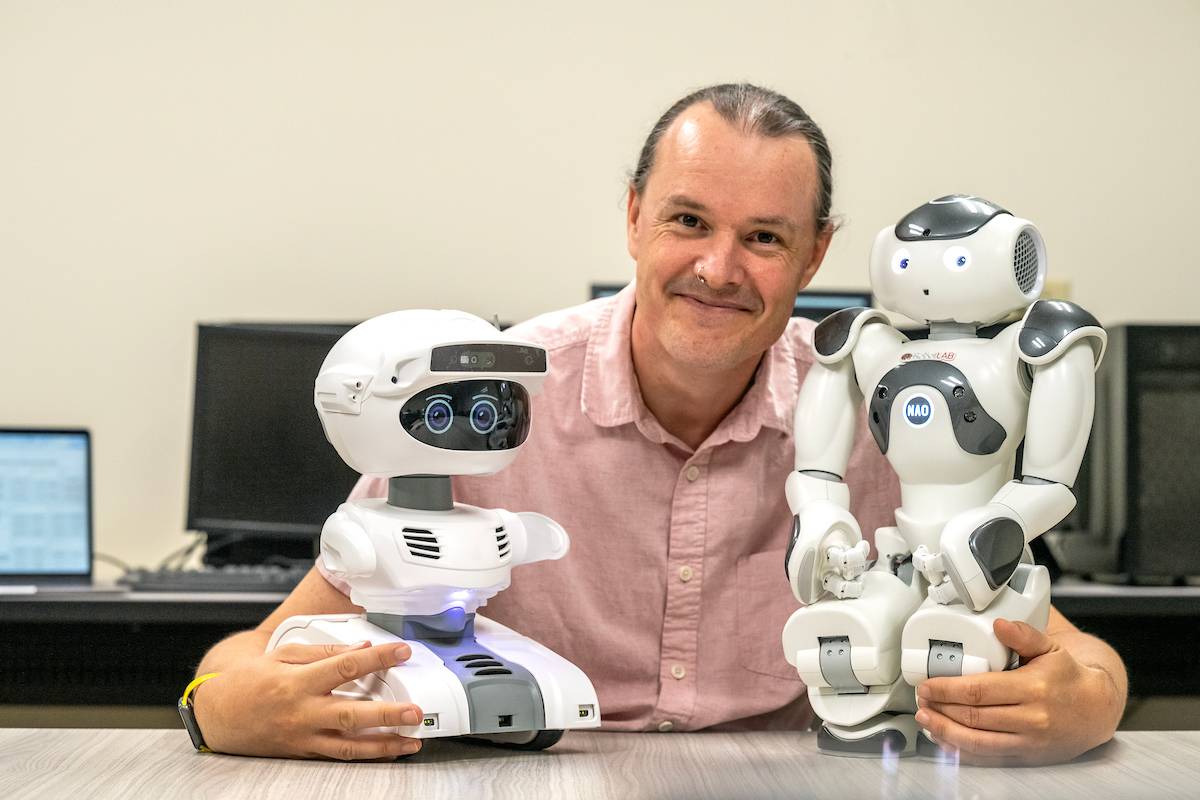
Child-Robot Interaction
Assistant Professor of Computer Science Jason "Willie" Wilson is developing advanced AI to help social robots interact more effectively with young children. Supported by a National Science Foundation CAREER Award, his research focuses on creating algorithms that utilize analogical reasoning to give robots a 'Theory of Mind.' This capability allows a robot to model and reason about a child’s mental state, including their beliefs and intentions. By understanding how a child thinks, these robots can provide more intuitive, personalized assistance that truly aligns with the child’s needs.
Neurosymbolic AI
Assistant Professor of Computer Science Justin Brody’s main research focuses on neurosymbolic AI, which is essentially trying to give AI the best of both worlds: the "instinct" of modern deep learning and the "logic" of classical approaches to AI. He approaches this in both a theoretical and practical sense. On the theoretical side, one project explores the limits of how AI understands images and text. He uses linear algebra and geometry to map out exactly what Vision Language Models (VLMs) models can—and can't—actually "see" or understand. His other project uses computer vision to tell real objects from fakes. Instead of just having the AI guess based on a picture, he integrates logical reasoning to hunt for specific "tells" that shouldn’t be there.
Digital Humanities
Professor Brody also does research in digital humanities, where he uses AI to solve mysteries in history and literature. In one project he uses Large Language Models (LLMs)—the same technology behind ChatGPT—to scan thousands of ancient Chinese Buddhist texts. His goal is to track how complex ideas evolved and changed over centuries. He also uses a branch of math called topology (the study of shapes) to look at how AI organizes language. Instead of just looking at words, he analyzes the geometric patterns the model creates to represent semantics, or the underlying meaning of a text. This allows us to extract a unique signature that represents the meaning of a piece of text. This signature is a way to identify when two different sentences are saying the same thing, even if they are worded differently.
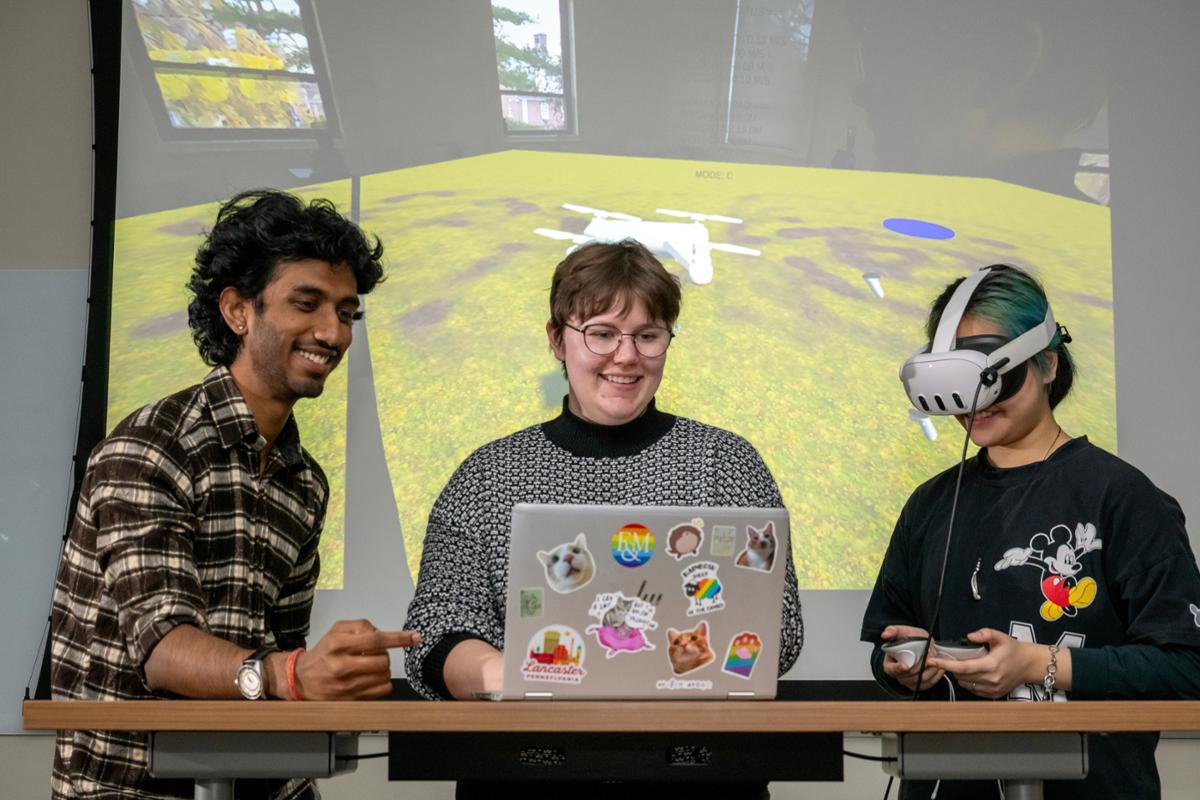
Intelligent Tutoring Systems
Assistant Professor of Computer Science Emily Jensen’s research investigates how we can use computational tools to automate parts of the training process. We can develop AI algorithms that take your data to assess your skill, generate feedback based on your performance, and give you new practice examples to help you improve. Students support this research in two ways: (1) They help develop the backend of a training system. We are building a code base for the training system using the Meta Quest headset and the Unity game engine. (2) Students help develop the theoretical structure of the training system. This involves researching what types of training tasks we will need and how we can transfer knowledge about how learning works into a computational system.
Adaptive Computation for Power Efficient AI
Most AI models use the same amount of computing power for every task, whether it's simple or complex. That's wasteful. Assistant Professor of Computer Science Brad McDanel’s research focuses on adaptive computation, designing systems that work smarter by adjusting their effort based on how hard a problem actually is. The networks he builds can "exit early" when they're confident in an answer, rather than processing every input through the entire model. Easy inputs get handled quickly; difficult ones get the full treatment. This idea extends to generative AI too, where a chatbot like ChatGPT could use less compute for a simple greeting and save its full capacity for a nuanced question. The result is lower energy use and faster responses.
AI @ F&M
These examples are just one facet of a campus-wide commitment to fostering human-centered AI innovation. Discover how F&M is framing AI as a tool for inquiry, teaching you to navigate its complexities with an ethical and responsible lens.
Explore AI @ F&M »