
F&M Stories
Behind the Scenes: Student-Coded Robots in Action
A global group of Franklin & Marshall seniors is shaping the way future visitors to the College interact with technology.
International students Yaruusan Altankhuyag ’26, Cristina Gao ’26, Inna Shapovalenko ’26 and HiuChun Wong ’26 spent the final weeks of the fall semester programming a robot to lead visiting students and families through a playful quiz about the College.
The group came together in a course titled “Human-Robot Interaction” (HRI), taught by Jason “Willie” Wilson, assistant professor of computer science.
“In class, we talk a lot about how ‘human’ the robot should look. How would you perceive this robot? Would you feel friendly or indifferent?” asked Altankhuyag, a computer science major and studio art minor from Ulaanbaatar, Mongolia.
F&M staff and students take a quiz about the College, led by a robot, as Yaruusan
Altankhuyag ’26 looks on. (Photo by Deb Grove)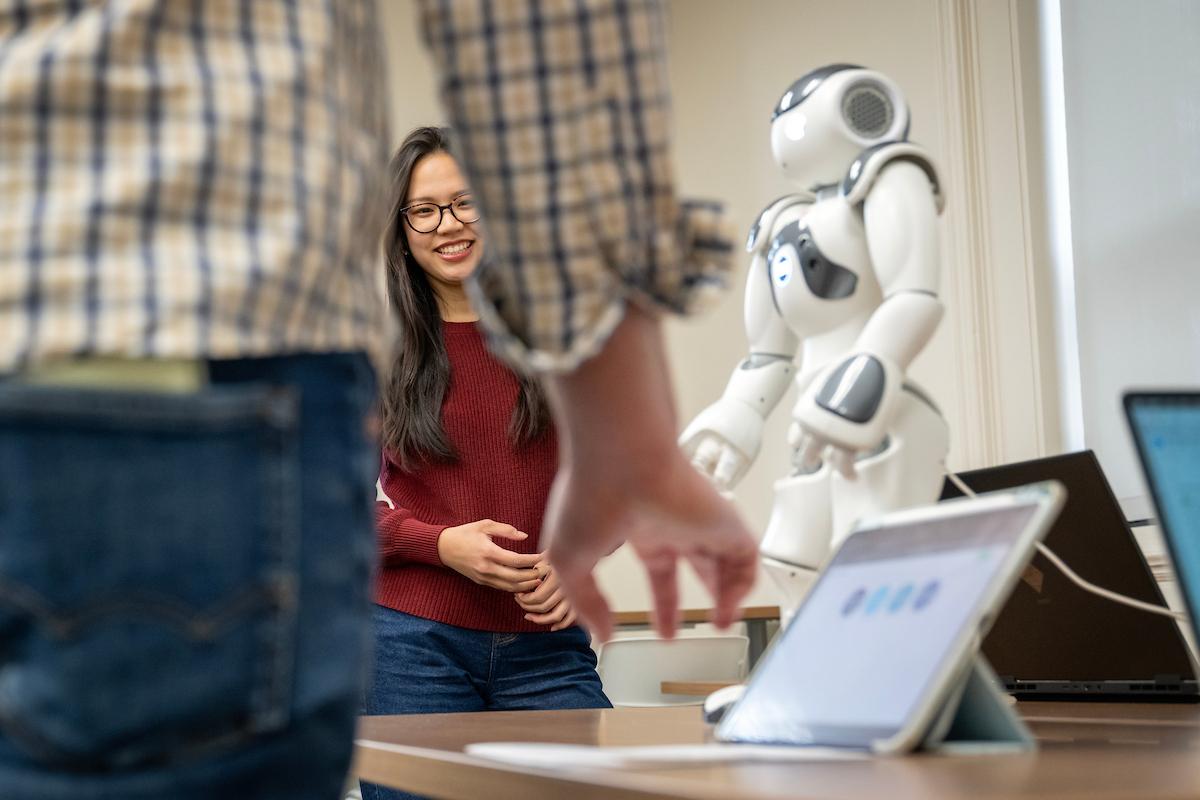
HRI “examines both the technology that makes it possible and the diverse and complex implications derived from interacting with people,” Wilson said.
A drop-in session before final exams opened the robot lab to F&M students and staff to interact with a trio of robots and provide feedback to student groups tasked with programming them.
HRI student groups interviewed admissions staff, faculty and other students to develop requirements for their individual robots, and then designed and developed the machine’s interactions.
Coding robots isn’t new for Shapovalenko, a computer science and physics double major from Chernihiv, Ukraine.
"I have a strong passion for hands-on mechanical and electrical engineering projects."
She assembled two versions of NASA STELLA spectrometers as a summer intern at the Space Science and Engineering Center (SSEC), a research center within the University of Wisconsin–Madison.
In summer 2024, Shapovalenko interned for Woods Hole Oceanographic Institution and developed an Unmanned Surface Vessel (USV), “a drone for exploring the ocean.”
“I have a strong passion for hands-on mechanical and electrical engineering projects," she said.
Still, the HRI project presented Shapovalenko with a new challenge. “I've never worked with this specific version of the robot,” she said. “I think the most important thing is working in a team.”
For Wong, the project provides a competitive advantage as he eyes a career merging cognitive science and machine learning.
“I see graduate school as a technical training so I can move forward to a doctorate in cognitive science,” said Wong, a cognitive science major from Hong Kong.
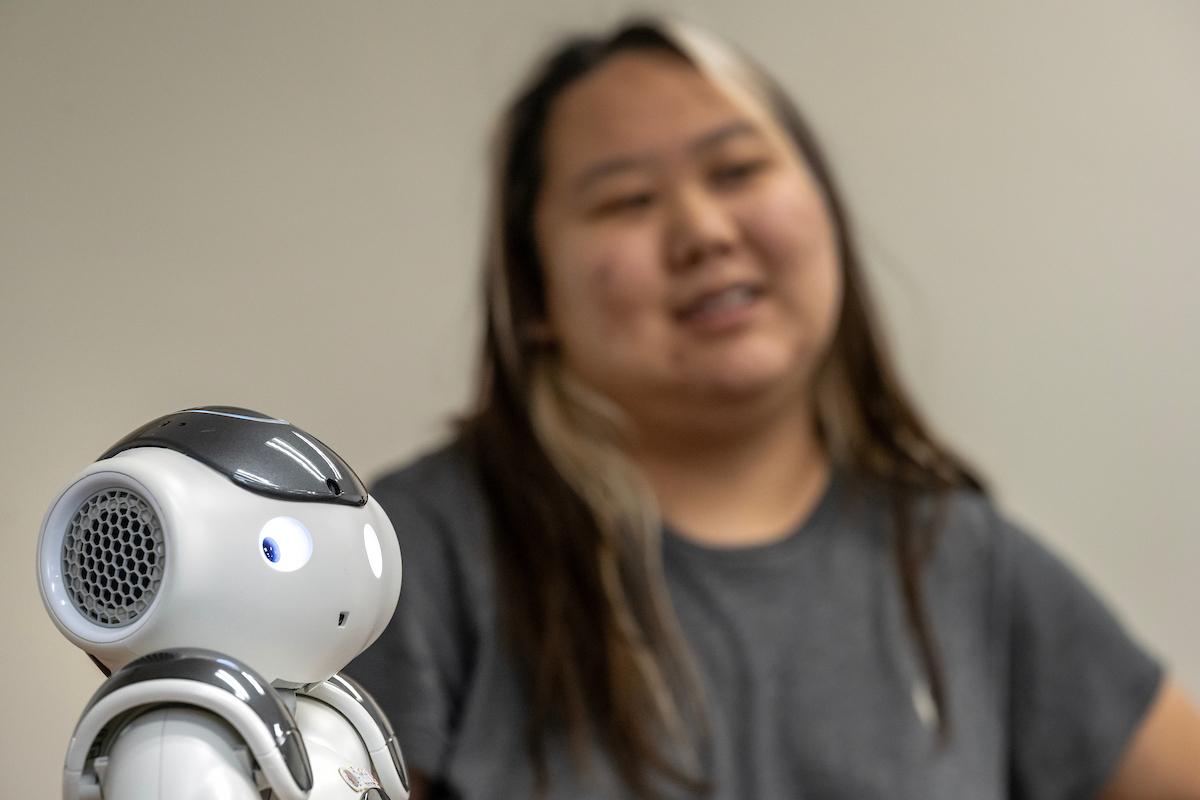
Cristina Gao ’26, of Beijing, discusses the rewards and challenges of coding a robot. She is a double major in computer science and cognitive science with a philosophy minor. (Photo by Deb Grove)
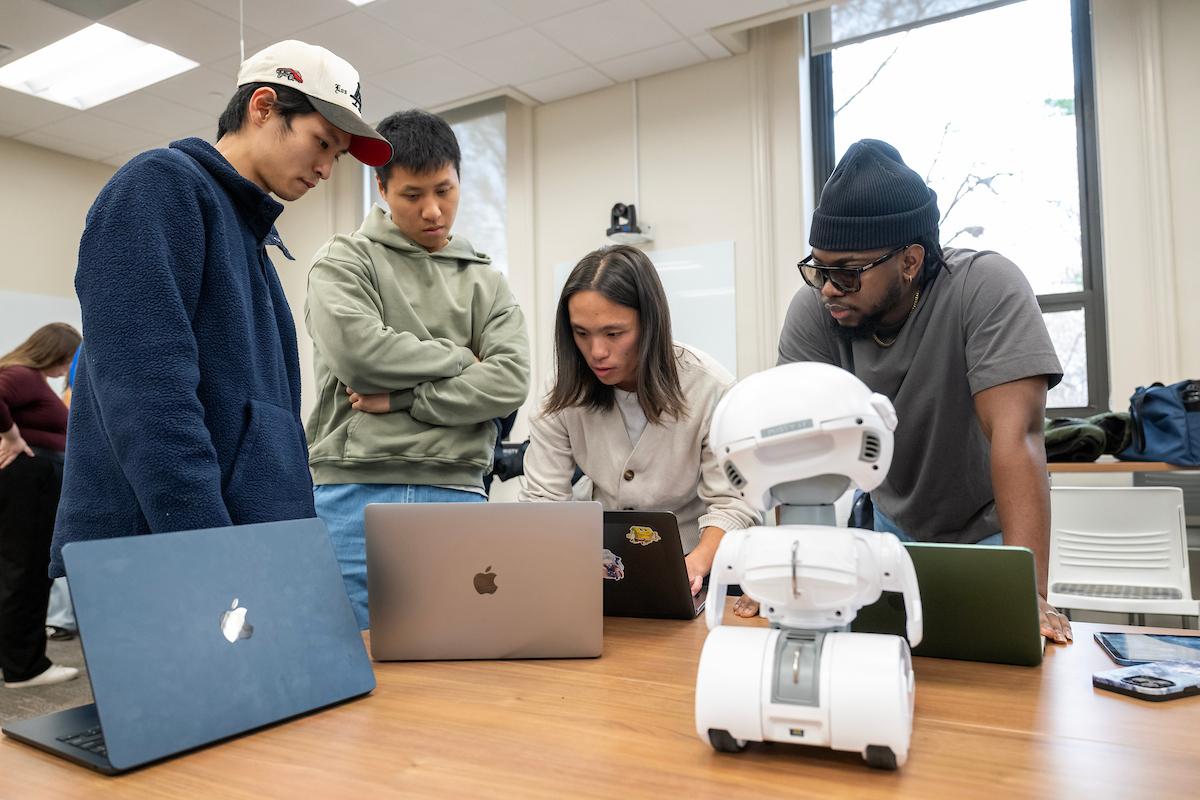
Students collaborate during a course titled “Human-Robot Interaction” (HRI), taught by Jason “Willie” Wilson, assistant professor of computer science. (Photo by Deb Grove)
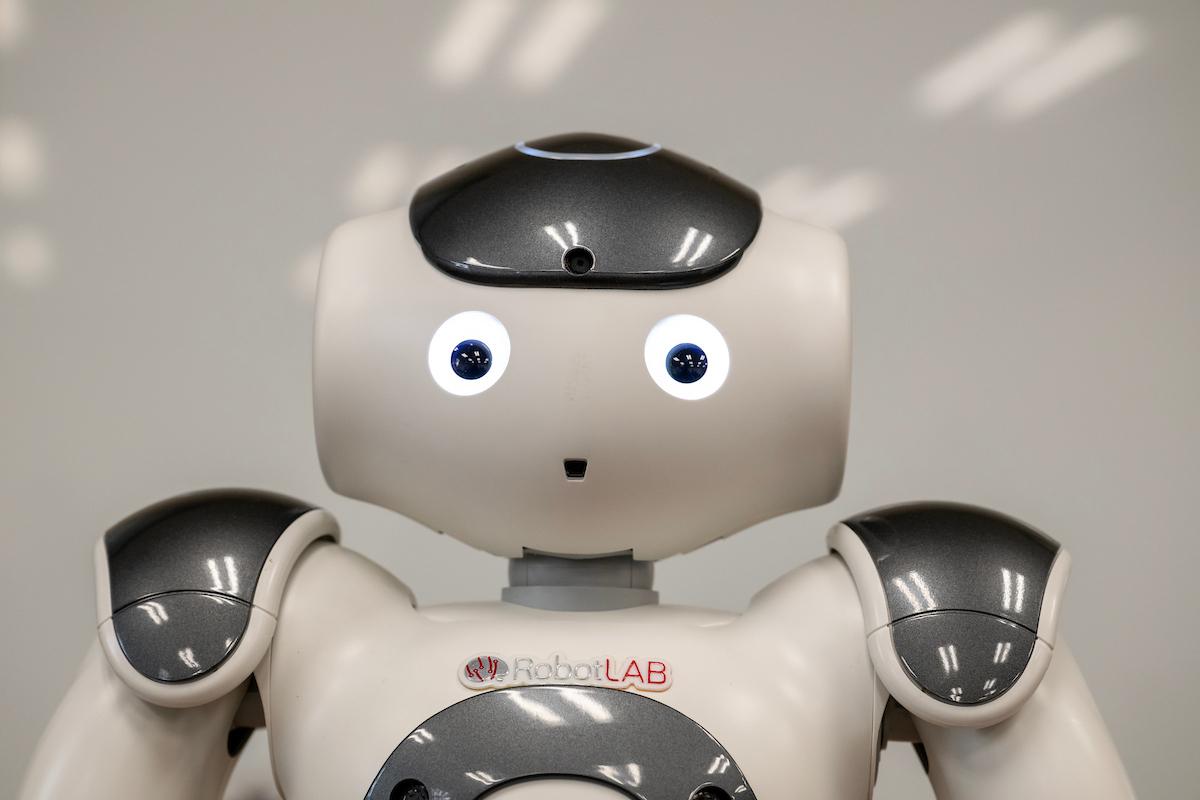
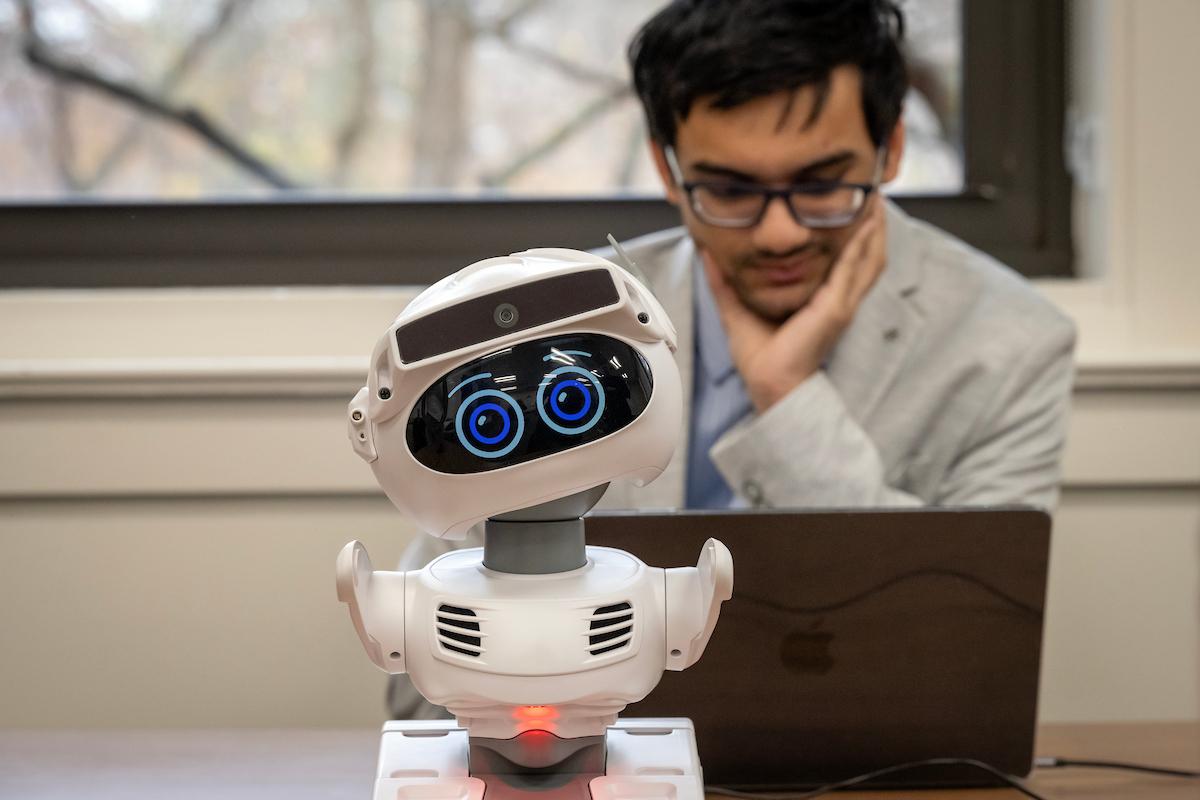
A closer look at one of the robots coded by computer science majors at F&M.
Students collaborate during a course titled “Human-Robot Interaction” (HRI), taught by Jason “Willie” Wilson, assistant professor of computer science. (Photo by Deb Grove)
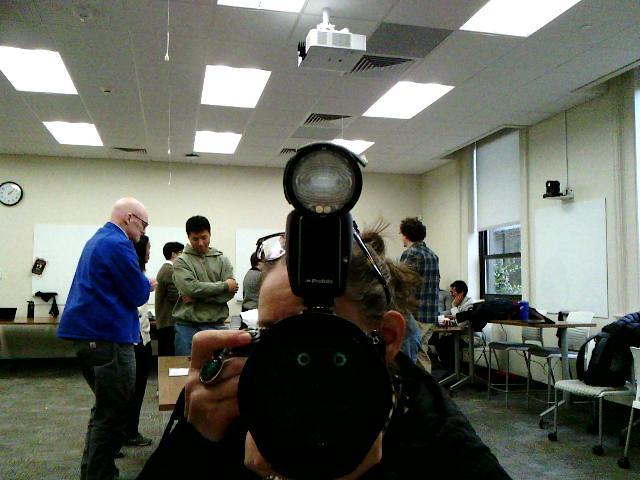
A student-coded robot captures an image of F&M staff photographer Deb Grove.
Creative Collisions in Research
Your ideas may start in the classroom, but they won’t be contained there. Learning by doing is part of our DNA as Diplomats. We prioritize the transformative power of hands-on learning to enhance your professional development experiences, including opportunities to participate in groundbreaking research.
Get Started »Related Articles
August 24, 2026
F&M and Fulton Bank: Where Liberal Arts and Innovation Meet
For Moemen Ibrahim ’26, an assignment to reach out to a Franklin & Marshall College alumna on LinkedIn led to much more than a career conversation. It became the beginning of an internship and an introduction to the world of innovation at Fulton Bank — and has also led to a full-time job.
July 20, 2026
F&M Experts Weigh in on Wildfire Air Quality
As Canadian wildfire haze blanketed the mid-Atlantic last week, local news sources turned to experts at F&M for air quality and public health insights. Professor of Geosciences Robert Walter '75 has been monitoring Lancaster’s air-quality index via a sampler machine atop of the Alumni Sports & Fitness Center.
June 1, 2026
F&M Computer Science Grad Lands Job at Google
At F&M, Shahina Tojieva ’25 cultivated world-ready skills to seamlessly transition from Diplomat to Google software engineer. “My time at F&M equipped me with the essential toolkit to navigate unfamiliar environments and overcome post-collegiate hurdles through a liberal arts lens,” she said.