
AI @ F&M
ANDREW RICH, PRESIDENT
“AI is reshaping how we learn, work, and lead. At F&M, our students learn not only
how to use powerful technologies, but how to question them, guide them, and apply
them responsibly to prepare for leadership in an ever-changing world.”
- Where Liberal Arts Meets AI
The pace of change is accelerating across industries, sectors, and cultures. With generative AI and other cutting-edge technological innovations poised to handle many entry-level duties, top-tier employers are increasingly seeking college graduates with the versatile skills and perspectives fostered by a liberal arts degree.
At F&M, we meet this shift by framing AI as a tool for inquiry, teaching you to navigate its complexities with an ethical and responsible lens. As you explore the technology’s potential, you will become technically proficient while sharpening the high-level critical thinking, ethical judgment, and creative problem-solving skills that are more important than ever. This is the F&M advantage: mastering the tools of the future while cultivating the timeless humanist perspectives that will set you apart.
Certificates are supplemental educational pathways you can pursue that are not tied
to your major or minor. The Artificial Intelligence and the Liberal Arts certificate
introduces a distinct approach to examine AI through a blended lens of humanistic
inquiry and technical proficiency. With coursework that spans the sciences and humanities,
the curriculum simultaneously explores the technology, its history, and its societal
implications. This foundation culminates in real-world, hands-on experiences, such
as internships or research projects.An AI Certificate to Prepare World-Ready Leaders
Jason "Willie" Wilson, assistant professor of computer science
“Our AI and the Liberal Arts certificate empowers students to ask the hard, timely
questions about AI.”
AI Across the Curriculum
AI has been taught and researched at F&M for over a decade. Just as technology never stands still, our curriculum adapts alongside the rapid pace of innovation. Balancing established, hallmark topics with rotating special-interest studies, F&M courses range from AI theory and algorithms to applications in biology, human-computer interaction, and child development. Faculty research — including projects funded by the National Science Foundation — spans the evolution of the field, from pioneering symbolic logic to novel deep-learning algorithms. F&M’s computer science department has spearheaded cutting-edge research into AI’s role in the classroom and led an initiative to develop an AI ethics curriculum for courses across the College.
Explore a sampling of recent courses that bridge the gap between technical mastery and humanistic inquiry — many of which are staples of the new Artificial Intelligence and the Liberal Arts certificate.
- Artificial Intelligence and You (Religious Studies)
- Intro to Bioinformatics (Bioinformatics)
- Minds, Machines, and Morals (Cognitive Science; Moral Psychology)
- Introduction to Data Science (Data Science)
- Introduction to Machine Learning (Computer Science)
- Sociology of AI (Sociology)
- Teaching and Learning Machine Ethics (Computer Science)
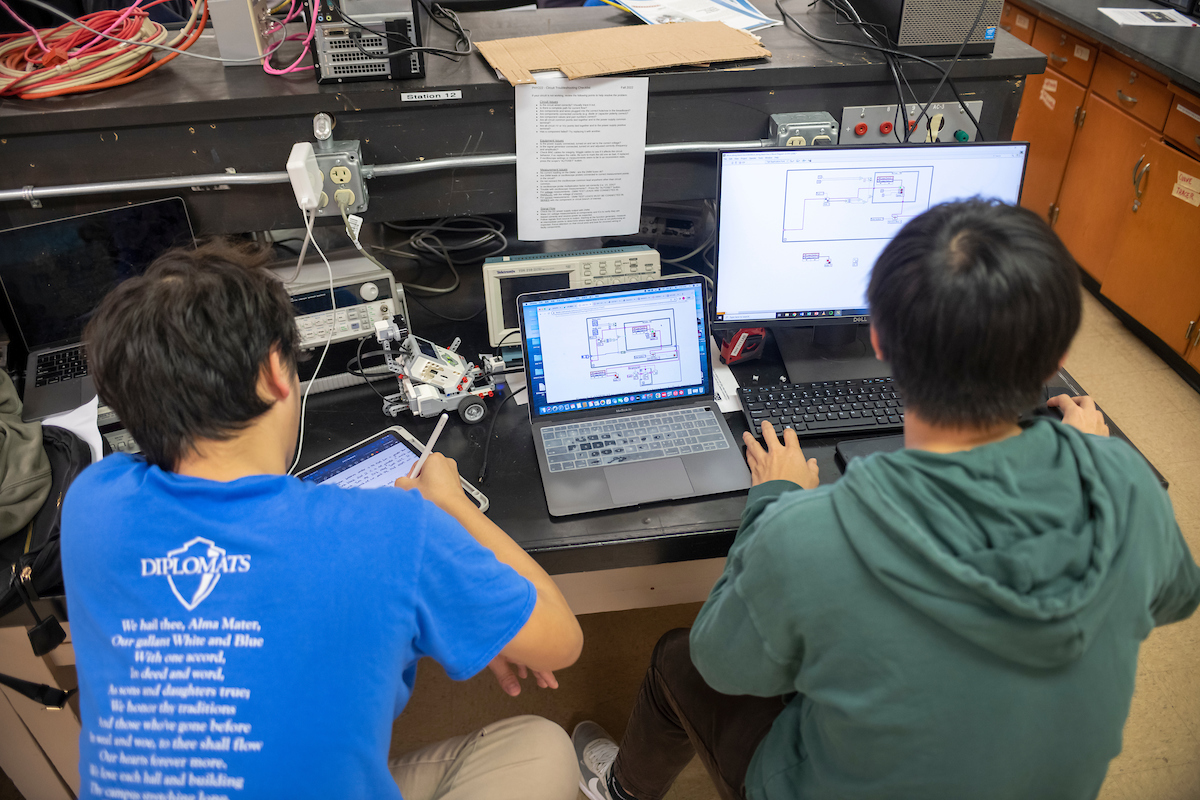
How do you study computer science through a liberal arts lens? Discover how F&M faculty
and students are meeting technical innovation with ethical judgment, critical thinking,
wisdom, and proficiency. Computer Science and AI at F&M
SUNITA KRAMER ’88, PROVOST
“We are both thoughtful and strategic about how we implement AI tools on our campus
— all while emphasizing the human-centered skills that AI cannot replace.”
Associate Professor of Sociology Caroline Faulkner and Senior Instructional Designer
Kelly Miller offered a four-part workshop for faculty to help them guide students
navigating AI for a wide variety of academic purposes. The series, “Beyond Abstinence
Only: What Our Students Need to Learn About AI,” focused on topics such as AI hype,
AI literacy frameworks and cognitive concerns, the ethical components of AI literacy,
and a look at future opportunities and challenges of AI. “Teaching and Learning Machine Ethics,” a course led by Assistant Professor of Computer
Science Jason “Willie” Wilson, did more than explore the basic fundamentals of AI.
It prepared students to teach machine ethics. The course’s students were separated
into groups and paired with a faculty mentor to create curricular material to be used
in future courses across campus. Along the way, students learned fundamentals of computer
science, AI, ethics and pedagogy. Hoping to harness the power of AI to help students learn, recent F&M grads Kirin Sawasdikosol
’24 and Dilrabo Kodirova ’25 developed a software startup, UniMind. The software gives
professors more control over whether and how AI is used by students. Faculty set parameters
on the use of AI to complete assignments; the software warns students if they violate
those guidelines, and alerts professors to the presence of AI-generated text. The course “Minds, Machines, and Morals” led by Josh Rottman, Associate Professor
of Psychology & Scientific and Philosophical Studies of Mind, examines the boundary
between artificial modeling and the human mind. Students explore if deep neural network
architectures could have the capacity for rationality and common sense, use experimental
prompts to test the cognitive limits of Large Language Models (LLM) such as ChatGPT,
and discuss how LLM architectures are fundamentally unable to recapitulate humanlike
intelligence. In a partnership with the Lancaster Nature Conservancy, Daniel Ardia, associate dean
of the faculty and Charles A. Dana Professor of Biology, is using AI to automate wildlife
detection in trail camera images. By integrating AI-based software into their research
workflow, the team can automatically differentiate between animals and humans in trail
camera images, saving hundreds of hours of manual labor. The team is now retraining
the AI models to identify specific species, providing a more detailed and efficient
look at local wildlife populations. Fronefield Crawford, Charles A. Dana Professor of Physics and Astronomy, and Tim Bechtel,
Senior Teaching Professor of Geosciences and director of F&M Science Outreach, are
working with students to leverage AI to detect surface landmines and tripwires in
mine-contaminated areas. Crawford and Bechtel serve on a NATO-sponsored international
research coalition with partners in Italy and Ukraine. Together, they are engineering
specialized robots and sensors designed to autonomously demine war-torn regions.Faculty Workshop: “Beyond Abstinence Only: What Our Students Need to Learn About AI”
Students Help Build an AI Ethics Curriculum
Student Startup Promotes Responsible AI Use
Minds vs. Models
Detecting Wildlife in Trail Camera Images
AI’s Humanitarian Frontier
Faculty Voices and AI
“As AI and automation increasingly take on routine tasks, business professionals will engage in analysis, strategic advising, and other high-impact projects earlier in their careers.”
“In the classroom, these technologies allow my students to focus more on developing the critical thinking, data interpretation, and communication skills they need to succeed in these endeavors.” — Harlow Loch, Assistant Professor of Accounting
“Students are navigating a world (and a job market) increasingly saturated with AI and part of our work as educators is to help young people think through the issues in rich and nuanced ways.”
— Erik Anderson, Associate Professor of English
“AI can help students master difficult concepts by providing endless practice problems and patient, encouraging feedback.”
“It also helps me make my class more inclusive and engaging since I can generate scenarios that are relevant to my students' lived experience while also targeting the concepts we are learning in class.” — Emily Jensen, Assistant Professor of Computer Science
AI Resources for the F&M Community
We offer a growing set of resources designed to support research, learning, and collaborative discovery in the age of AI. These include:
-
- Google Workspace & Gemini: A unified campus-wide digital infrastructure featuring Google Workspace and Gemini, Google’s AI LLM, ensuring all students, faculty, and staff have access to advanced collaboration and generative AI tools.
- Generative AI @ F&M Guide: A dedicated site hosted by F&M’s Information Technology Services (ITS) featuring guidelines and considerations for generative AI use, as well as practical tools and resources for the campus community.
- Student Resource Guide: A curated site by F&M’s Instructional Technology team featuring AI tools and guidance for students, including an AI guide from the College Library, specialized tools to enhance learning, and a practical flowchart to help determine the responsible use of generative AI for specific assignments.
- High-Performance Computing Capabilities: A shared high-performance computing cluster used for AI and compute research, which centralizes resources, enables faculty and students to complete research more quickly, allows researchers to scale up their research and look at solving larger problems, and facilitates more student research and student/faculty collaboration.
- F&M's Department of Computer Science: A team of expert faculty actively engaged in AI research, scholarship, programming, and collaborations.
- Interdisciplinary Programming: Campus-wide events on AI, including a Common Hour event featuring a panel of F&M professors and students and sponsored by the computer science, economics, and religious studies departments.
- Faculty Integration Toolkit: A comprehensive online hub for faculty to navigate the integration of generative AI into higher education. The hub provides foundational knowledge through a curated list of articles, videos, and podcasts; offers practical guidance on crafting classroom policies; highlights tools that streamline research, assist neurodivergent students, and generate interactive classroom discussions; and more.
- Collaborative Learning Circles: Book groups, workshops, and more designed to foster faculty conversations about AI and explore how these tools can support, rather than replace, student learning.
Imagine 1,600 computer processors combining power toward one task. This is the engine
driving innovation at F&M. Called a High-Performance Computing (HPC) cluster, this
elite shared resource accelerates discovery, empowers large-scale research, and fuels
the collaborative spirit that defines the F&M experience.Powering Innovation: Inside F&M’s Campus Supercomputer
CARRIE RAMPP, VICE PRESIDENT AND CHIEF INFORMATION OFFICER
“F&M has always been well ahead of the curve when it comes to providing technology
infrastructure that supports any and all forms of teaching, learning and research
that can benefit from advanced technology resources.”